Rulers: Saint-Martin: History
Saint-Martin
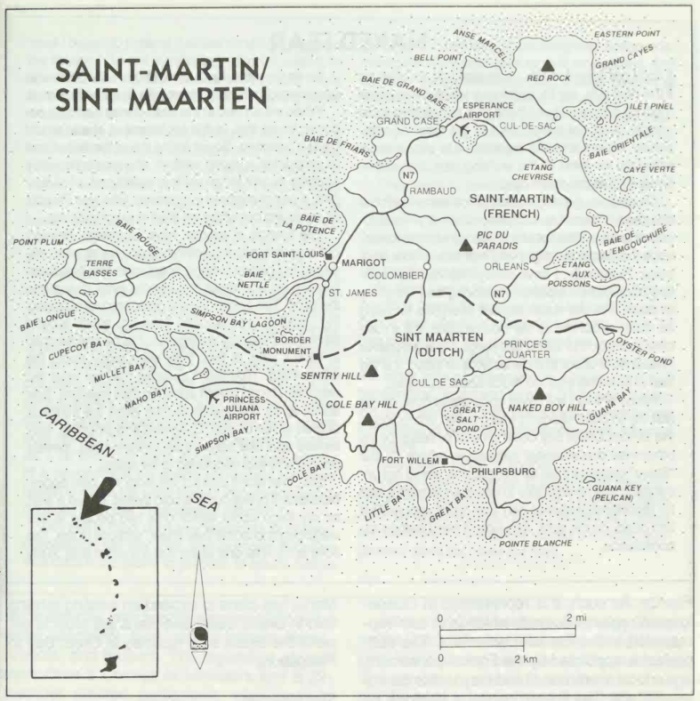
Saint-Martin is the French part (making up about 60%, the remainder being the Dutch Sint Maarten) of Saint Martin, a small volcanic island in the Leeward group of the Lesser Antilles in the Caribbean Sea, 8 km south of Anguilla and 265 km northwest of Guadeloupe. The 10-km border between the French (northern) and Dutch (southern) sections is the only land frontier in the Lesser Antilles and makes Saint Martin the world's smallest inhabited island to be divided.
The French (hyphenated) name Saint-Martin is here strictly used to refer to the French part and the English (unhyphenated) name Saint Martin for the entire island. In local colloquial usage (English being the dominant language), instead of referring to Saint-Martin and Sint Maarten, the English name is used and distinction is made between "the French side" and "the Dutch side" or similar. Even in French and Dutch, an equivalent nomenclature is common, so it is possible to refer to the respective other part in French as "Saint-Martin, partie néerlandaise" or in Dutch as "Sint Maarten, Frans gedeelte."
c. 2000 BCE: By this time Ciboney (or Archaic) people live on the island, based on archaeological evidence from the Norman Estate site in Saint-Martin. Later the island is intermittently inhabited by Arawaks (c. 800-1300 CE) and by the Caribs who displace them; their name for the island is Soualiga, meaning "salt land," after the various natural salt pans found in the island.
Nov. 11, 1493: By common assumption, Cristóbal Colón (Christopher Columbus), the famous explorer, during his second voyage sails past the island on St. Martin's Day and names it after the patron saint (St. Martin of Tours, who lived in the 4th century and famously shared his coat with a beggar). However, in these early days the names of small islands are sometimes confused, and there is good evidence that it was actually Nevis which Colón named St. Martin (and on November 12, which incidentally at the time is also the feast day of a St. Martin, the 7th-century Pope Martin I), that he may or may not have seen St. Martin on November 13, and that the names later settled differently. The present association appears first on the Portuguese Reinel map of 1516, where the island is labeled Sam Mtim.
July or early August 1629: Some Frenchmen arrive on the island (where Dutchmen paid a visit before in 1624) when Captain Giron, on a reconnaissance mission to find out if there are Spanish ships in the neighbourhood of St. Christopher, got into a gale, lost his mast, and had to look for shelter at the nearest island. After having repaired his ship, he leaves again.
End of August or beginning of September 1629: After the Spanish drove the French and English off St. Christopher, the French, amidst whom is Pierre Belain d'Esnambuc, arrive on St. Martin and make an entrenchment in case the Spaniards pursue them. The French are disappointed in the island, however; the water is brackish. A part of the French leave after some days under d'Esnambuc for some place else; others stay behind, forming the first settlement. After a short while the Spaniards visit and destroy the entrenchment.
1630: The Spanish not having sufficient ships and crew to occupy St. Christopher permanently, the English and French return. 14 Frenchmen, however, stay behind in Saint-Martin. They make salt at the modern location of Grand Case and live slightly to the east, in French Quarter or Quartier d'Orléans. The small settlement even gets an official character when their leader, referred to as sieur de Saint-Martin, receives letters of commission in this capacity from the French king.
Early August 1631: The Dutch occupy the island, thinking it uninhabited, only meeting the Frenchmen later when they move farther into the island. By 1633 the Dutch colony is definitely larger than the French one.
June 24, 1633: A Spanish fleet of 53 ships (11 men-of-war convoying 42 merchant vessels) appears, having orders to capture St. Martin, whose cheap salt is an unwanted competition to the Spanish state salt monopoly. 1,000 foot-soldiers and 300 sailors are put ashore. The Dutch keep up a fierce resistance for a week, but have to surrender on July 1. The Spaniards allow all inhabitants to leave and hoist the Spanish flag. The island then suffers from the general neglect from which other Spanish islands in the neighbourhood also suffer. The Spanish garrison consists of civil servants and soldiers, no colonists.
March 20, 1644: Petrus Stuyvesant, director of the Netherlands West India Company in Curaçao, shows up at St. Martin with a fleet of 13 ships. He is badly wounded early on and the Spaniards repulse the attack. After a three weeks' siege the Dutch leave on April 17.
Early 1648: The Spanish abandon the island of their own accord. The Dutch initially try to prevent a French return but Philippe de Longvilliers de Poincy, captain-general of St. Christopher and governor-general of the French Antilles, believes he has a right to lay claim to the island for France on the strength of its being earlier settled by his compatriots, which induces him to send his nephew Robert (whom he grants a commission as governor) to St. Martin with 300 troops. After a skirmish having possibly taken place on March 17, an amicable settlement is arrived at when a partition treaty is signed on March 23 on top of a mountain named Mount Concordia (Mont des Accords) in memory of this fact. In the treaty it is agreed
(1) that the French shall continue in that quarter where they are established at this present, & that they shall inhabit the entire coast which faces Anguilla;
(2) that the Dutch shall have the quarter of the fort, and the soil surrounding it on the south coast;
(3) that the French and Dutch established on the said island shall live as friends and allies, and that, in case of either party molesting the other, this shall constitute an infringement of this treaty, and shall therefore be punishable by the laws of war;
(4) that, if a Frenchman or Dutchman being guilty of a criminal act or an infringement of this agreement, or of disobedience to the commands of his superiors, or of whatever other remissness, shall withdraw to the territory of the other nation, the contracting parties shall be bound to cause such person to be arrested in their territory, and to deliver him up to his governor on the latter's first requesting it;
(5) that the chase, the fisheries, the salt-pans, the rivers, the lakes, the fresh waters, the dye-wood, mines and minerals, harbours and roadsteads, and other commodities of the said island shall be common, and shall serve to provide the wants of the inhabitants;
(6) that it shall be permitted to French persons at this present residing with the Dutch to join the French, if it so pleases them, and to take with them their movables, foodstuffs, and money and other commodities, provided they have settled their debts or given sufficient security, and that the Dutch shall be able to do likewise and on the same conditions;
(7) that, if enemies should attack one part or the other, the parties to this treaty shall be obliged to render each other aid and assistance;
(8) that the delimitation and partition of the said island between the two nations shall be submitted to the general of the French and the governor of Sint Eustatius, and to the deputies that shall be sent to visit the places; and that, their report having been made, they shall delimit their quarters, and proceed in the manner stipulated above;
(9) that any claims one party may have against the other shall be submitted to the king of France and the gentlemen of His Council, and to the Prince of Orange and the States of Holland. Neither of the above parties shall be able to construct fortifications without contravening the above agreement and compensations with respect to the other party.
There is no evidence of Article 8 being carried out. (A famous legend that the island was partitioned by a walking match, starting at Oyster Pond on the east coast, with a Frenchman going in northerly and a Dutchman in southerly direction, and from where they would meet a line would be drawn to Oyster Pond, has no basis in reality.) Subsequently both the French and the Dutch begin a move toward the interior of the island, which is considered safer than the coast. The French settle in the Quartier d'Orléans.
May 24, 1651: Saint-Martin and Saint-Barthélemy are purchased by the Order of Malta, de Poincy setting the condition that he remain as governor of these islands. This gives the islands greater security from Spain, which would not want to offend the powerful order. However, they are purchased back by the Compagnie des Indes Occidentales (Company of the West Indies) in 1665.
1658: A Walloon clergyman who travelled in the area, Charles de Rochefort, narrates that about 300 people inhabit the French part and an equal number the Dutch part. In the production of tobacco St. Martin surpasses all the neighbouring islands.
1661: After Jules Cardinal Mazarin's death Huguenots settle in Saint-Martin.
April 1672: In the first violation of the treaty, the French take control of the entire island when the two countries are at war in Europe.
June 15, 1676: The Dutch become masters of the island, but already on June 30 the French regain the upper hand. A Frenchman's report of the Dutch naval attack near the French Quarter salines is evidence of the presence of black slaves by this time: "They [the enemy] burned the churches and the cabins on the side where they attacked, where the inhabitants lost their Negroes, their cattle, and all their possessions; and as my house happened to be right there, I have lost 21 Negroes (I have only one left)..."
1687: There are 720 whites in the French part and 278 slaves.
Jan. 18, 1690: An English force lands and by January 27 the French are driven away, taking refuge in St. Christopher. The English do nothing with the island, however.
Sept. 20, 1697: The peace treaty of Rijswijk restores the former situation.
1699: The French resume possession.
1702: France orders all inhabitants to move to other French islands. The reasons are unknown, and not all Frenchmen obey the order. Those who stay behind move to Marigot Bay, formerly surrounded by a few scattered fishermen's cottages but where since about 1689, when a small fortification was erected on the hilltop, a village was coming into being. The name Marigot is a French West Indian word used for a spot from which the rainwater does not drain off and forms marshy pools.
April 10, 1703: The entire island comes under Dutch rule by an accord between Lucas van Beverhoudt, a merchant acting as authorized representative of Isaac Lamont, the governor of Sint Eustatius, and "the citizens."
1705: A French Dominican missionary, Father Jean-Baptiste Labat, visits the island. He reports that the French community has a rectory and a small church, but no parish priest. He writes that there was a resident priest, a Capuchin friar, but he was murdered in 1699 by his own servant, a Carib, and the Capuchins refused to send another priest, Saint-Martin thereafter being served intermittently from St. Christopher.
April 11, 1713: The peace treaty of Utrecht restores the French part to France. As St. Christopher becomes British, Saint-Martin becomes a dependency of Guadeloupe instead. French administration resumes slowly. In August 1715 a certain Martel is mentioned as lieutenant du roi on Saint-Martin, yet it appears to be not until March 15, 1717, that François de Lauriol arrives to take possession for the king. The Dutch vice-commander, Martinus Meyers, requests that the Frenchman leave the island, a request the latter naturally refuses. The 1648 treaty is so little known at the time that, when Meyers sends a copy of de Lauriol's commission to Jan Simonsz Doncker, the commander of Sint Eustatius, the latter also finds the situation peculiar; however, lacking the necessary manpower, neither Meyers nor Doncker can take action, and de Lauriol remains in control of the French sector.
Late 1717: Disregarding the actual state of affairs, the Chamber of Amsterdam of the Netherlands West India Company appoints a certain Louis Guillaume Durepaire as commander of Sint Maarten - without addition that his jurisdiction is limited to the Dutch part. Durepaire is a runaway Frenchman, who spent some time with the Spaniards in Santo Domingo and was subsequently in chains on St. Thomas, but managed to escape. He knows neither Dutch nor English. Upon his arrival on the island in May 1718, he encounters opposition in the Dutch part, and de Lauriol naturally does not recognize his authority over the French part.
July 14, 1734: The 1648 treaty being apparently forgotten again, a new treaty is concluded between Nicolaas Salomonsz, a councillor on Sint Maarten (authorized by Johan Heyliger, the commander of Sint Eustatius), and the governor of the French Antilles, Jacques Charles Bochart. It stipulates that in the event of a war between France and the Netherlands, the island will remain neutral and that in the event of an attack from abroad, the French and Dutch commanders will assist each other. Another provision, prohibiting the importation of slaves or other items (effets) in wartime, leads to complaints by the British envoy in The Hague, deeming the article detrimental to British trade, and is one of the factors that drive the British to attempt to cripple the island's trade.
1736, 1743, 1745: The Dutch commander, John Philips, urges the West India Company to purchase the French part. He finds a supporter in the commander of Sint Eustatius, Johannes Heyliger Pzn., who points it out in connection with economic motives (sugar and cotton) in 1746.
1740: There are at this time 40 whites in Saint-Martin, of whom only 11 are French, the rest Englishmen, Irishmen, and a few Dutchmen and Italians.
1744: During the War of the Austrian Succession (1743-48), two British privateers take Marigot. The British hold Saint-Martin until the end of the war.
1755: The Rev. George van Essen of Sint Eustatius, a native of Germany, writes a letter to an acquaintance at the court of King Friedrich II (Frederick the Great) of Prussia, suggesting to buy Saint-Martin; his motives are unclear. The letter is apparently intercepted by the commander of Sint Eustatius and reported to the Amsterdam Chamber of the Netherlands West India Company, which replies that the clergyman should mind his own business and not engage in proposals to foreign sovereigns. The letter has no further consequences, as Prussia in any case is not yet considering the acquisition of colonies.
1756 and 1764: The demarcation line is given some shape for the first time.
1759: During the Seven Years' War, the British occupy French Saint-Martin. They fill up the wells and try to make the island uninhabitable.
1763: As the war ends the French, who took refuge in the Dutch part, return. The governor of Guadeloupe, François Charles de Bourlamaque, rejects an offer made by Abraham Heyliger, the Dutch vice-commander of Sint Maarten, to buy the French part for 100,000 piasters. It is only in 1764 that France officially takes possession. The chevalier de Fénelon, commanding the frigate La Folle, then also takes possession of the small island of Tintamarre, or Flat Island, northeast of Saint-Martin, which was occupied by Englishmen, based on some private transaction, for some 40 years; it has about 150 inhabitants at this time. The administration system of Saint-Martin is changed: instead of the governor of Guadeloupe, the French government will appoint the commander of Saint-Martin and Saint-Barthélemy; the two islands form one district until 1785, when the latter becomes Swedish. Auguste Descoudrelles, the first commander under the new system, does what John Philips did some decades before in the Dutch part: promoting the settlement of foreigners. When Descoudrelles steps down in 1785, the population has increased from about 1,000 to about 3,000, 2,500 of whom are slaves; the 500 whites are of a variety of nationalities, only a minority French.
1767: Fort Saint-Louis at Marigot begins to be built on the foundations of the earlier fortification dating from 1689.
1768: Marigot becomes a parish proper.
Jan. 5, 1779: The British invade Saint-Martin. A strong French offensive under Charles Henri Hector, comte d'Estaing, recovers the island on February 25.
Feb. 4, 1781: Adm. George Bridges Rodney seizes the island.
Nov. 27, 1781: The French drive the English away and take over the administration of the entire island.
Feb. 11, 1784: The Dutch part is restored to the Dutch pursuant to the 1783 Treaty of Versailles.
1785: A commandant particulier, representing the governor of Guadeloupe in Saint-Martin, begins to be appointed. Jean-Sébastien, chevalier de Durat, is the first holder of the office.
1786: There are 431 whites in the French part and 2,572 slaves. As slaves are often bought in English-speaking islands in the neighbourhood, with little direct importation from Africa, the English language comes to dominate.
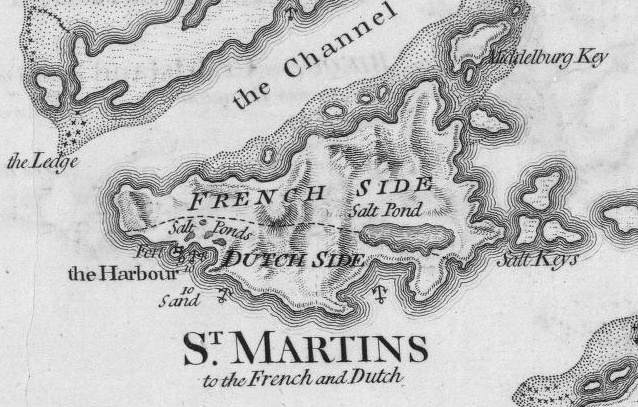
1788 map of the island. |
1789: The French Revolution leaves the inhabitants of the French islands divided between royalists and revolutionaries. From Guadeloupe the latter agitate in Saint-Martin, contrary to the wishes of de Durat.
May 19, 1793: As the Netherlands and France are at war, the only fight between Dutch and French St. Martin takes place. A little army of some 20 men commanded by Lt. Abraham Heyliger Lzn. seizes Fort Saint-Louis in a surprise attack while it is still dark. At daybreak he hoists the Dutch flag and names the fort Willem Frederik (after the future King Willem I). The terms of surrender include a remarkable final provision, namely that the enemies of just order, "that is to say the adherents to atheism and murderers of the king," shall have to leave the island by order of Commander Willem Hendrik Rink. For the next two years French Saint-Martin is under Dutch rule, though it continues to be a separate administrative unit. 116 people take an oath of allegiance to the Dutch Estates-General. A Provisional Council is instituted, consisting of three local merchants, Jean Rouvellet, president, and John Mardenbrough and a certain Romney, members.
1794: The clergy flees to Anguilla and the church is burnt down.
April 5, 1795: As the Dutch republic has become a satellite of France, the entire island comes under French rule. Although the Dutch commander remains in office, he has to take orders from the French commander. When the official delegate from the National Convention in Paris, La Bruyère, arrives on April 29 with a company of dragoons, he immediately confiscates the properties of 21 of the 51 European inhabitants of Saint-Martin (35 English and 16 French); all slaves are proclaimed free (which also undermines slavery in the Dutch part given the ease of escaping to the other side). With a view to controlling Great Bay and Little Bay at the same time, the French at once build a fortification, called Bel-Air, on the spot where Stuyvesant also mounted his battery in 1644.
March 24, 1801: The British drive away the French, landing undisturbed in Little Bay out of range of the French guns on Bel-Air. The English put an end to Marigot's export trade, as a result of which the little town falls into decay.
Nov. 27, 1802: The Dutch take control again following the Treaty of Amiens. In early 1803 the French part is returned to France, which, meanwhile, under First Consul Napoléon Bonaparte, restored slavery in May 1802.
July 3, 1808: An unsuccessful attack on the island is made by the British ships Wanderer and Subtle. Lt. George Spearing lands with 135 men and soon gains possession of the lower fort, but on ascending the rocky heights, covered with prickly pear, he and several others are shot from the upper fort and the survivors are obliged to surrender. The French commandant, as a mark of respect, attends Spearing's funeral.
Feb. 14, 1810: The British again arrive to take over the island, the French immediately complying with the capitulation earlier concluded at Guadeloupe; the Dutch surrender on February 16.
Jan. 24, 1815: The British hand back the French part to France (the Dutch are given back their part only a year later). A military commander then governs Saint-Martin. The function of the commandant particulier, though the office continues to exist until 1870, loses importance, being merely the link between the governor in Guadeloupe and the military commander.
1816: Population: 3,362 (including 315 whites).
1817: Methodism is introduced in both parts by Anguillan John Hodge. He begins to preach on the French side to the slaves. The French authorities, alarmed by his denunciation of slavery and his call for social justice, force him to leave. He then moves to the Dutch side, where his powerful preaching draws increasingly large crowds. His success there has an influence back on the French side, which was 100% Catholic through the 18th century and becomes 25-50% Methodist by the mid-19th century. (Due to later population movements, the Methodist percentage drops again significantly.)
Sept. 21, 1819: A hurricane, accompanied by an earthquake, hits the island. Marigot and the Dutch part's capital Philipsburg are turned into heaps of ruins. Swedish Saint-Barthélemy offers first aid.
Jan. 29, 1823: Guadeloupe is divided into five municipalities, one being Saint-Martin. Military commander Louis Auguste Elliott institutes a municipal council with himself as president and 10 members, including 4 ex officio and 6 appointed by the military commander. At first this council exists only on paper. In December 1828 it becomes reality along with the division of Saint-Martin into two quartiers, Marigot and Grand Case. The presidents are Capt. Abraham Zymonsz Doncker until his death, followed (Feb. 16, 1832) by Capt. Pierre Philippe O'Reilly until 1838.
1835: When in the Dutch part a concession system is introduced for the Great Salt Pond, in violation of Article 5 of the partition treaty, the French government starts démarches. This results in the formulation of a new treaty in 1839 (see below).
July 21, 1838: A new municipality is introduced, joining the two districts again, with a mayor (maire) and two aldermen (appointed by the governor of Guadeloupe) and a council chosen under census suffrage. This replaces the civil administration by the military commander. On July 25 Georges Dormoy is appointed mayor. He stays in office until 1866.
Nov. 28, 1839: A new convention is signed by the Dutch administrator, Diederik Johannes van Romondt, and the French commandant particulier, François Louis Forget:
1. The treaty of 1648 and all those that may have been concluded since then between the authorities of the Dutch part and the authorities of the French part shall be considered null and void and annulled by these present ones.
2. The inhabitants of both parts of the island shall have the privilege of hunting and fishing along the entire coastline; the salt marshes shall also be held in common, and salt collected on either territory shall be subject to the export duties required by the laws of both dependencies.
3. The contracting parties, also considering that the goal of enlightened administration would only have a positive effect if there were perfect agreement regarding the concept of abuse of justice in respect of individuals who are subject to a judgment, whether for debts or other more serious offenses, and who would flee to one or another dependency to seek refuge, have agreed that no protection shall be afforded to them, their arrest being immediate; extradition shall take place as far as possible within 24 hours, in the usual forms and upon request.
4. This agreement, drawn up in two originals, shall take effect only upon the approval of Their Excellencies the governors of Suriname and Guadeloupe.
On Jan. 15, 1841, the Dutch governor-general in Suriname ratifies the convention; there is no evidence of French ratification.
1841: A new Catholic church is constructed in Marigot.
1847: A Catholic church is constructed in Grand Case. Both Catholic churches are dedicated to St. Martin of Tours.
May 28, 1848: Slavery is abolished in Saint-Martin. (Again this also makes slaves on the Dutch side virtually free, though official Dutch abolition follows only in 1863.) In 1849 the French government enacts legislation providing a compensation of 400 francs per slave to the former owners; 25 plantation owners and 85 merchants benefit from this.
1849: The first public primary school opens in Marigot.
March 1849: The French plantation owners start to conclude contracts with their former slaves, now employees, but without much lasting success. In the same year St. James is the first plantation to be cut up. And in 1850 Industrie (Friars Bay) follows, in 1851 the plantations Rambeau and Concordia. Eventually this happens to all estates. The growing of sugarcane, the heyday of which was around 1760, comes to an end. Many white French leave the island for this reason, and the French language further loses ground.
1853: As a result of hampering customs regulations, at this time all consumer goods for Saint-Martin are
imported via Philipsburg.
May 3, 1854: The suffrage is abolished, the councillors now being appointed too.
1858: Great expansion of the salt industry on both sides of the island is planned when François Auguste Perrinon, a former army officer from Martinique, forms a salt-making company. The French government through its embassy in The Hague declares that it no longer considers operative the agreement that the salt pans should be the general property of the inhabitants, and Perrinon succeeds in obtaining from the Dutch government a royal decree allotting to him the largest concessions in the Great Salt Pond.
Aug. 2, 1860: An additional agreement is concluded (and ratified August 23) between the Netherlands and France, regulating the application of an 1844 treaty on the extradition of wrongdoers to the two countries' borders in the Caribbean area (i.e. on St. Martin and between French Guiana and Suriname).
1867: As the economic conditions in Sint Eustatius have deteriorated, the governor of Curaçao (and its dependencies), Abraham de Rouville, advises the Dutch government in The Hague to exchange Saint-Martin for Sint Eustatius (and possibly Saba too), thus bringing St. Martin entirely under Dutch rule. The Dutch government considers the plan seriously and de Rouville receives permission to contact the French semi-officially, but ultimately nothing comes of it.
July 1, 1867: Louis de Durat is appointed mayor.
Dec. 3, 1870: Universal suffrage is introduced for the Municipal Council.
July 30, 1871: Charles Claude Sainte-Hélène Télèphe is appointed mayor. He dies November 16 and is succeeded by Victor Foulquier.
1874: Mayor Foulquier dies. Pierre Auguste Beauperthuy becomes acting mayor.
1876: A French government commission reports that "nothing has been able to prevent Saint-Martin's sliding on the fatal down slope on which she found herself already several years before the date of Emancipation. The large cultivated lands have been abandoned; out of 30 sugar works, only three continue to exist and they can barely produce the sugar necessary for a population of 2,956 souls." The commission recommends "absolute freedom of trade and absolute exemption from taxes" as the only hope for prosperity.
May 29, 1876: Beauperthuy is appointed mayor.
May 7, 1878: Mayor Beauperthuy dies. Charles Becker becomes acting mayor.
July 12, 1879: Jean Frédéric Becker is appointed mayor.
March 28, 1882: A law of Aug. 12, 1876, is made applicable to Guadeloupe, providing for mayors to be elected.
1884: Due to the large-scale evasion of duties on the border, it is stipulated that it is no longer allowed to export overland, but that everything has to go by sea. This only results in an intensification of the contraband trade. Gradually the import and excise duties, therefore, just disappear.
1891: Mayor Jean Frédéric Becker dies. Charles Becker becomes acting mayor.
1902: With intent to grow cotton, Diederik C. van Romondt, settles on the uninhabited island of Tintamarre. He lives there with some 100 servants, 60 or 70 cows, and 540 sheep, as the uncrowned "King of Tintamarre," a title bestowed on him in a 1913 newspaper article by a French reporter who visited him - with the result that unmarried Frenchwomen eager to share his idyllic existence on the Caribbean island write him letters. "D.C.," as he is known, remains a bachelor until his death in 1948 in Mary's Fancy, Sint Maarten, where he went in 1932 after having sold Tintamarre to Mayor Louis Constant Fleming in 1931.
May 1907: The road from Philipsburg via Cole Bay to Marigot is made passable for vehicles.
1912-January 1951: Dutch Dominican friars act as priests in Marigot after the diocese of Basse-Terre et Pointe-à-Pitre (Guadeloupe) could no longer provide parish priests for Saint-Martin.
1919: The church of Grand Case is pulled down. A new one is dedicated in 1921.
1926: French nuns, who worked in Saint-Martin since 1801, leave for lack of money. Their hospital then falls completely into decay.
November 1929: Two small seaplanes settle down on the bay at Marigot.
1931: Marigot obtains a direct steamship connection via Martinique and Guadeloupe to the United States, as a result of which prices drop so sharply that the Dutch side - from where exports to the French side always existed - is left with its goods.
c. 1934: When Sint Maarten acquires a local telephone network, a telephone link is also constructed between Philipsburg and Marigot. Two telephones are installed in Marigot: a public telephone in the post office with a branch connection in the office of the mayor, Louis Constant Fleming, who has a private line laid from his office to his country house Bellevue. The French, however, do not maintain the line on their territory and already in 1941 it can no longer be used. However, the mayor's private line remains intact.
1937: The first hotel in the island, Beau Séjour, is opened in Marigot by Mayor Louis Constant Fleming, also a shrewd businessman.
1939: All remaining import and excise duties between the two parts are abolished.
May 12, 1940: Following the German occupation of the Netherlands in World War II, the commander of the French maritime forces in Marigot, acting on orders from his superior, informs the administrator of Sint Maarten, Johan Diderich Meiners, that, from this day, French troops will take the Dutch part of the island under their protection; quarters are requested for this purpose. Pending a decision on the matter by the governor of Curaçao, the administrator makes lodging available in the so-called Brick Building; 20 men arrive under the command of a lieutenant. On May 14, the governor informs the administrator that he approves of the measures. After France itself falls, the troops quietly depart on June 23.
July 1940-July 1943: The French Antilles are loyal to the Vichy government in France. In the Catholic churches, the prayer sung on Sundays, "Domine, salvam fac rempublicam" ("Lord, save the republic"), as was customary in France, is replaced by "Domine, salvum fac servum tuum Philippum" ("save your servant Philippe," i.e., Marshal Philippe Pétain), by order of the bishops. Mayor Fleming, however, does not follow regulations to hang the portrait of Pétain.
1946: Aviation pioneer Rémy de Haenen, who has established his base on Tintamarre, establishes the Compagnie Aérienne Antillaise. The airline is set back, however, by a series of three disasters with fatalities in 1947.
March 19, 1946: Guadeloupe (including Saint-Martin) becomes an overseas département.
Jan. 1, 1948: Saint-Martin becomes a canton of the arrondissement of Basse-Terre, Guadeloupe, as part of an "assimilation" policy.
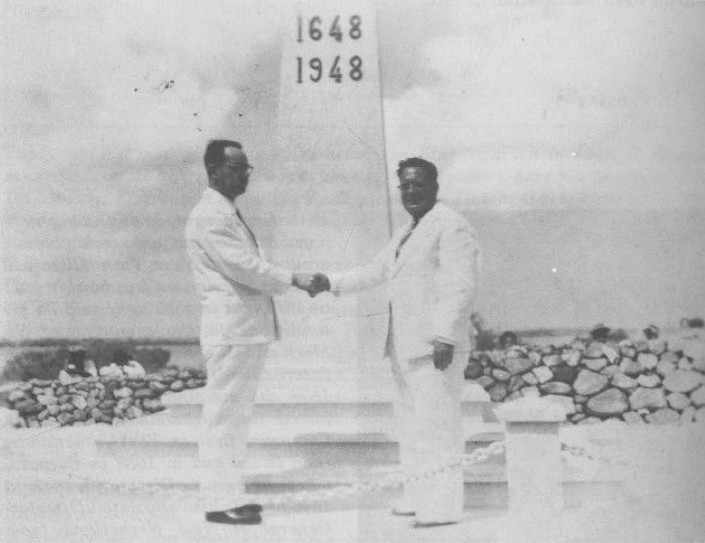
Johannes Christiaan Paap (left), administrator of Sint Maarten, and Louis Constant Fleming, mayor of Saint-Martin, shake hands on March 23, 1948, on the occasion of the unveiling of the frontier monument. |
March 23, 1948: To symbolize the goodwill prevailing between the Dutch and French parts a monument is erected on the borderline at the third centenary of the 1648 treaty. On April 14 Gilbert Philipson, prefect of Guadeloupe, and Piet Kasteel, governor of Curaçao, officially meet at the border.
1949: The French government builds a new hospital in Marigot.
Jan. 29, 1949: Mayor Louis Constant Fleming dies. His brother Élie Fleming becomes acting mayor, and is elected mayor in March.
Sept. 1, 1950: A hurricane puts an end to the old airplanes still on Tintamarre. The last airstrips are erased by the 1956 and 1960 hurricanes.
1954: Population: 3,360 (male 1,595; female 1,765).
1956: A post office is constructed in Marigot.
May 1957: A "road over the mountain" is completed.
1958: Father Gerard Kemps, born in the Netherlands but working in Saint-Martin since 1954, composes what becomes a popular anthem for the whole island:
O Sweet Saint Martin's Land
Where over the world, say where,
You find an island there,
So lovely small with nations free,
With people French and Dutch,
Though talking English much,
As thee Saint Martin in the sea?
Chorus:
O sweet Saint Martin's Land,
So bright by beach and strand
With sailors on the sea
And harbours free,
Where the chains of mountains green
Variously in sunlight sheen,
|: O, I love thy Paradise,
Nature-beauty fairily nice! :|
How pretty between all green
Flamboyants beaming gleam
Of flowers red by sunlight set!
Thy cows and sheep and goats
In meadows or on roads,
Thy donkies keen can't I forget.
Saint Martin, I like thy name,
In which Columbus' fame
And memories of old are closed.
For me a great delight:
Thy Southern Cross the night.
May God the Lord protect thy coast!
March 15, 1959: Fernand Hubert Petit is elected mayor. During the year he suggests that November 11, St. Martin's Day (which, being also Armistice Day, is conveniently already a French holiday), should be proclaimed a joint feast-day. The Dutch Island Council agrees. Each November 11, accordingly, the border is the scene of festivities which also serve to inaugurate the tourist season for both the Dutch and French parts.
Sept. 4-5, 1960: Hurricane Donna sweeps the island.
1961: The last salt harvest is recorded.
Feb. 1, 1963: A decree (Journal Officiel, February 7) creates the arrondissement of Saint-Martin-Saint-Barthélemy (also called Îles du Nord) within the overseas département of Guadeloupe. Guy Maillard becomes the first sous-préfet in Marigot.
April 1, 1965: The Banque des Antilles Françaises, the first commercial bank in Saint-Martin, opens in Marigot.
1969: The hotels Grand Saint-Martin and Le Pirate open.
July 21, 1972: A small regional airport, L'Espérance, is inaugurated at Grand Case on the banks of the former salt pond. Princess Juliana International Airport on the Dutch side remains the main international hub for both sides. It has been speculated that, in the wake of the events in nearby Anguilla where the British landed troops after a local rebellion against rule by the larger St. Christopher, the French considered a similar possibility on Saint-Martin and wanted to be able to land armed forces by air without having to seek permission from The Hague.
1974: Census population: 6,191.
1977: The telephone service is automated.
March 13, 1977: Élie Fleming is elected mayor.
March 1978: The Hôtel de Ville (town hall) in Marigot opens.
1979: There are now 8 hotels with a total of 329 rooms.
March 9, 1982: Census population: 8,072.
March 13, 1983: Albert Fleming is elected mayor.
July 11, 1986: The so-called Loi Pons reduces the income taxes of individuals and introduces tax breaks for companies. This leads to a massive expansion of tourism. The number of hotels increases by more than 30 between 1986 and 1992. Marinas are constructed to attract luxury yachts. Luxurious shopping precincts and large residential areas are constructed in Marigot.
1989: Ahead of the municipal elections of this year, the Flemings, who used to live on the Dutch side, move across the border, as the mayor was criticized for his living "abroad."
March 15, 1990: Census population: 28,518, a massive increase in 8 years, corresponding to an annual growth of 17%.
November 1996: The Movement for Advancement of the People (MAP) is created by Louis Mussington, Alain Richardson, and Sujah Reiph. It wins its first contested elections in March 1998, electing Mussington to the General Council of Guadeloupe.
Sept. 3, 1998: The Saint-Martin Nature Reserve (Réserve Naturelle de Saint-Martin) is established, including Tintamarre, most of the waters between it and the main island, and parts of the latter's northern and eastern coast.
March 8, 1999: Census population: 29,079. French of metropolitan origin or from Guadeloupe constitute over 65% of the total population, with those said to be originally from Saint-Martin estimated at 15%. The proportion of the population that originally came from Haiti is 11%; their acceptance has been interpreted as part of a French policy to strengthen the local position of the French language.
Dec. 7, 2003: Saint-Martin votes decisively (76.2%) to become a separate territory of the French Republic. It is to be ruled by a collegial executive body, elected by the assembly from among its members.
Jan. 1, 2006: Census population: 35,263.
Feb. 6, 2007: The reorganization is approved by the French Senate and the following day by the National Assembly. On February 21 Saint-Martin is formally designated an overseas collectivity (collectivité d'outre-mer), as is Saint-Barthélemy. Both come under a joint prefect (based in Saint-Martin) delegated to the prefect of Guadeloupe, the latter being from July 9 also state representative in Saint-Barthélemy and Saint-Martin.
March 7, 2007: Dominique Lacroix is appointed prefect of Saint-Barthélemy and Saint-Martin. He takes office March 21.
July 1, 2007: In the first round of elections to the Territorial Council (Conseil territorial), the list of Louis Constant Fleming, Union for Progress (Union pour le Progrès), wins 40.3% of the vote, that of Alain Richardson, Rally, Responsibility, Success (Rassemblement, Responsabilité, Réussite; RRR), 31.9%, that of Jean-Luc Hamlet (Réussir Saint-Martin) 10.9%, the Alliance list, headed by Dominique Riboud, 9.1%, and Wendel Cocks' Alliance démocratique pour Saint-Martin 7.8%. Turnout is 46.4%. As no list emerges with an absolute majority, a second round, on July 8, is contested by the three parties that secured more than 10% of the vote. Fleming's list wins 49.0% of the vote (16 of 23 seats), Richardson's 42.2% (6), and Hamlet's 8.9% (1). Turnout is 50.8%. On July 15 Fleming is unanimously elected president of the Territorial Council and an Executive Council is unanimously elected consisting of Marthe Ogoundélé (first vice-president), Daniel Gibbs (second vice-president), Claire Guion-Firmin (third vice-president), Pierre Aliotti (fourth vice-president), and Jean-Luc Hamlet and Alain Richardson (members). Pending the election of one member of the French Senate and one deputy (jointly with Saint-Barthélemy) to the National Assembly, the territory continues to be represented by the Guadeloupean delegates.
July 25, 2008: Fleming is removed from his post of president of the Territorial Council, the French Council of State having disqualified him for one year owing to financial irregularities. Marthe Ogoundélé becomes acting president.
Aug. 7, 2008: Frantz Gumbs is elected president of the Territorial Council, defeating acting president Marthe Ogoundélé by 15 votes to 7, with 1 abstention. By a vote of 16-1 with 6 abstentions, an Executive Council is elected with Daniel Gibbs (first vice-president), Claire Guion-Firmin (second vice-president), Pierre Aliotti (third vice-president), Louis Jeffry (fourth vice-president), and Alain Richardson and Marthe Ogoundélé (members).
Sept. 21, 2008: Fleming, representing the Union pour un Mouvement Populaire (UMP), is elected as Saint-Martin's representative to the French Senate, winning 17 votes in the 24-member electoral college, against 5 for Guillaume Arnell and 2 for Louis Mussington.
April 10, 2009: The Council of State annuls the August 2008 election of Gumbs as president of the Territorial Council due to the use of pre-printed ballots with his name. Daniel Gibbs takes office as acting president on April 14 pending a re-run of the election, which is to be held within 30 days.
May 5, 2009: The Territorial Council again elects Gumbs as president with 16 votes, against 6 for Alain Richardson and 1 for Marthe Ogoundélé. Aline Hanson becomes a member of the Executive Council instead of Ogoundélé, in the only change from August 2008.
June 6, 2009: In European Parliament elections (conducted, like subsequent elections, one day earlier than in mainland France due to the time-zone difference, so as not to be influenced by mainland results), turnout in Saint-Martin is 11.1%. The list of Harry Durimel (Greens) wins 57.7% of the vote.
Dec. 1, 2009: Saint-Martin becomes an "outermost region" of the European Union as the Treaty of Lisbon comes into force.
Nov. 16, 2011: Philippe Chopin is named prefect. He takes office December 12.
March 18, 2012: In elections to the Territorial Council, RRR wins 34.1% of the vote, Team Daniel Gibbs 2012 32%, Union pour le Progrès 13.3%, and Saint-Martin pour tous 9.4%. Turnout is 52%. A second round is held March 25, RRR winning 56.9% of the vote (17 of 23 seats) and Team Daniel Gibbs 2012 43.1% (6).
April 1, 2012: Alain Richardson, the leader of the ruling RRR, is unanimously elected and sworn in as the president of the Territorial Council. The following become vice-presidents: Aline Hanson (1st), Guillaume Arnell (2nd), Ramona Connor (3rd), and Wendel Cocks (4th), with Rosette Gumbs-Lake and Daniel Gibbs completing the Executive Council.
April 21, 2012: In the first round of the French presidential election, François Hollande (Socialist Party) wins 35.3% of the votes in Saint-Martin, compared with 34.0% for Nicolas Sarkozy (UMP) and 12.5% for Marine Le Pen (National Front); turnout is 31.0%. A runoff election is held two weeks later, at which Hollande, who also wins nationwide, secures 51.5% of the vote, against 48.5% for Sarkozy; turnout is 38.1%.
June 9 and 16, 2012: In an election to the National Assembly the UMP's Gibbs (officially known as Gibbes, owing to an error in registration) is chosen to represent Saint-Barthélemy and Saint-Martin. In the first round, he wins 39.9% of the vote, Guillaume Arnell (diverse left) 25.6%, and Louis Mussington (Socialist Party) 16.7%; turnout is 30.1%. In the second round, Gibbs wins 52.3% and Arnell 47.7%; turnout is 35.9%.
Sept. 6, 2012: Christophe Hénocq is elected to the Executive Council after Gibbs resigned.
November 2012: Legislation to impose price controls on a range of staple goods and encourage competition in Saint-Martin and other French overseas possessions is approved by the National Assembly.
April 17, 2013: Aline Hanson is elected president of the Territorial Council after Alain Richardson was removed from the post and declared ineligible for 18 months by the Council of State for breaching campaign finance regulations. On the new Executive Council Guillaume Arnell becomes first vice president, Ramona Connor second vice president, Wendel Cocks third vice president, Rosette Gumbs-Lake fourth vice president, and Jeanne Rogers-Vanterpool and Christophe Hénocq members.
Dec. 31, 2013: Fleming resigns as senator.
2014: A border dispute arises when French authorities challenge the Dutch-side position that all the water in Oyster Pond falls under Sint Maarten's authority. The dispute produces confrontations between authorities and places strain on relations between the two governments.
May 24, 2014: In European Parliament elections, turnout in Saint-Martin is 10.7%. The UMP list wins 37.8% of the vote and the National Front list 16.9%.
Sept. 28, 2014: The left-wing candidate Guillaume Arnell is elected as senator. In the first round of voting, Arnell and Alain Gros-Desormeaux (RRR) win 7 votes each, Dominique Aubert 6, and René-Jean Duret 2, with 1 blank vote. In the second round, a relative majority being sufficient, Arnell wins with 11 votes, against 8 for Gros-Desormeaux, 4 for Aubert, and 1 blank vote.
October 2015: Further legislation to monitor prices on the island is adopted.
November 2015: After attacks in Paris by militants connected to the Islamic State group and the declaration of a state of emergency in mainland France earlier in the month, this is expanded to cover the French Caribbean territories as a precautionary security measure. The local police are thus granted wide-ranging powers of arrest and the authority to prohibit public demonstrations.
April 6, 2016: After 20 years of negotiations, Saint-Martin and Sint Maarten conclude a treaty on their shared maritime boundaries.
June 2016: Saint-Martin becomes an associate member of the Association of Caribbean States.
July 2016: The MAP announces it will be replaced by a new political movement. This becomes the Movement for Justice and Prosperity (Mouvement pour la justice et la prospérité; MJP).
January 2017: Census population: 35,334.
February 2017: The National Assembly adopts the Loi Égalité Réelle Outre-mer (Real Overseas Equality Act) to address the high cost of living and the lack of socioeconomic development in the territories.
March 19, 2017: In the first round of elections to the Territorial Council, Team Gibbs 2017 wins 49% of the vote, the MJP, led by Louis Mussington, 13.7%, Moving Towards Progress (En marche vers le progrès; MVP), led by Alain Richardson, 12.3%, Generation Hope, led by Jules Charville, 8.7%, and Continuons pour Saint-Martin, led by Aline Hanson, 6.4%; turnout is 42.7%. In the second round on March 26, Team Gibbs 2017 wins 64.3% of the vote (18 of 23 seats), MJP 24.1% (4), and MVP 11.5% (1); turnout is 45.5%.
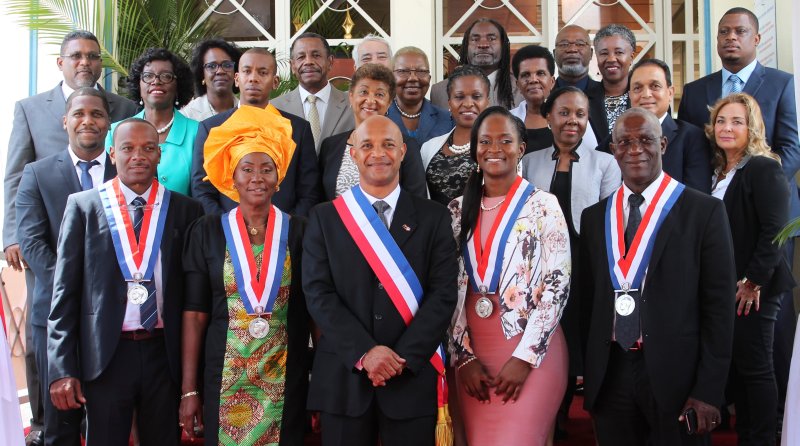
President of the Territorial Council Daniel Gibbs (centre) flanked by the four vice-presidents, (left to right) Steven Patrick, Annick Pétrus, Valérie Damaseau, Yawo Nyuiadzi, April 2, 2017. |
April 2, 2017: Daniel Gibbs is elected president of the Territorial Council (18 votes, with 4 blank votes and 1 invalid vote). In unanimous votes, Valérie Damaseau becomes first vice-president, Yawo Nyuiadzi second vice-president, Annick Pétrus third vice-president, and Steven Patrick fourth vice-president. Marie-Dominique Ramphort and Louis Mussington complete the Executive Council.
April 22, 2017: In the first round of presidential elections, François Fillon of Les Républicains, third-placed nationally, wins the most votes in Saint-Martin, 27.2%, followed by Marine Le Pen of the National Front (23.8%), Emmanuel Macron of the En Marche! movement (22.1%), and Jean-Luc Mélenchon of La France insoumise (16.9%); turnout is 26.3%. In the runoff on May 6, Macron, who also wins nationally, wins 67.9% in Saint-Martin against Le Pen's 32.1%; turnout is 30.9%.
June 10 and 17, 2017: Claire Guion-Firmin (also known by her maiden name, Claire Javois) of Les Républicains is elected to represent Saint-Barthélemy and Saint-Martin in the National Assembly. In the first round, she wins 26.0% of the vote, Ines Bouchaut-Choisy 21.8%, Jacques Hamlet 18.9%, and Marthe January 10.2%; turnout is 24.0%. In the second round, Guion-Firmin wins 54.7% of the vote and Bouchaut-Choisy 45.3%; turnout is 26.1%.
June 29, 2017: Former president of the Territorial Council (2013-17) Aline Hanson dies.
September 2017: Hurricane Irma devastates the territory, killing at least 11 people and destroying more than one-half of all buildings. The French government declares a state of natural disaster and dispatches more than 2,000 security and medical personnel to aid in relief efforts and restore order. During a visit in November, Prime Minister Édouard Philippe announces a series of financial measures to support the territory. It is projected that reconstruction costs in Saint-Martin and Saint-Barthélemy (which was also devastated by the storm) will reach €3,000 million.
November 2017: The state of emergency is terminated following the adoption of new anti-terrorism legislation.
December 2017: France notifies the United Nations of the international border dispute.
March 2018: The French government promises at least €370 million in aid for Saint-Barthélemy and Saint-Martin.
April 11, 2018: The Council of State declares Alain Richardson and Jules Charville ineligible for a year for campaign financing violations. Richardson is also dismissed from the Territorial Council, where he is replaced by Ramona Connor.
June 18, 2018: Sylvie Danielo-Feucher is appointed prefect, to take office July 9.
September 2018: President Emmanuel Macron visits Saint-Martin, calling for a reassessment of the Natural Hazard Prevention Plan (Plan de Prévention des Risques Naturels; PPRN), to reduce the vulnerability of the island's buildings to flooding, hurricanes, and other natural occurrences.
May 25, 2019: In elections to the European Parliament, local turnout is 12.6%. The National Front list wins 29.6% of the vote, the La République en marche list 17.7%, the Union of the Right and Centre 10.8%, and Europe écologie 10.1%.
July 2019: The Territorial Council votes to reject the amended PPRN, taking issue in particular with its ban on seaside reconstruction in certain zones, which would exacerbate the housing crisis; however, the Council lacks power of veto and the PPRN comes into force in December.
October 2019: Daniel Gibbs and two of the Council vice-presidents (Valérie Damaseau and Annick Pétrus) are charged with violating laws on public procurement in the aftermath of Hurricane Irma; Gibbs is also accused of embezzlement. All three maintain their innocence.
November 2019: A Senate report declares that reconstruction work is only 49% complete in Saint-Martin, two years after Hurricane Irma. An ongoing lack of potable water is finally resolved in December. Public dissatisfaction with the PPRN results in demonstrations in the same month: roadblocks are erected and cars and tyres are set on fire, prompting the deployment of army reinforcements.
March 17, 2020: Measures to prevent the spread of coronavirus disease (COVID-19), including the closure of non-essential businesses, are implemented. Further restrictions on movement are introduced a week later. A phased reopening of businesses, schools, and public places begins in May. Rising rates of infection are a cause for concern in late October and early November, as Saint-Martin would normally be preparing for its tourist season.
July 2020: During a visit, French minister of overseas territories Annick Girardin announces several modifications to the PPRN to reassure the populace.
Sept. 27, 2020: One of the charged vice-presidents, Annick Pétrus (Union for Democracy/Les Républicains), is elected to the Senate. In the first round of voting she obtains 10 votes (short of the 13 needed), Marthe Ogoundélé (Les Républicains) 6, and Guillaume Arnell (diverse left) 5. In the second round, Pétrus wins 15 votes, Ogoundélé 5, and Arnell 2.
Nov. 11, 2020: In his Saint Martin's Day address, Gibbs proposes the formation of a "United Congress" as a joint consultative body for the French and Dutch sides of the island.
Nov. 25, 2020: Serge Gouteyron is appointed as prefect. He takes office December 15.
January 2021: A COVID-19 immunization programme begins. As a preventive measure, borders are closed to most travellers from early February. By April 4, according to World Health Organization figures, 1,687 cases of COVID-19 have been reported in Saint-Martin, with 13 deaths, a rate of 33.6 per 100,000 of the population.
March 9, 2022: Vincent Berton is appointed prefect. He takes office March 28.
March 20, 2022: In the first round of elections to the Territorial Council, Rassemblement Saint-Martinois (RSM, formerly MJP) wins 25.4% of the vote, Team Gibbs 2022 24.7%, Generation Hope 2022 17.5%, Saint-Martin avec vous 13.8%, Alternative 11.2%, and Avenir Saint-Martin 7.5%; turnout is 46.6%. The 23 seats are allocated in a second round on March 27, when the alliance of RSM and Alternative wins 49.1% of the vote (16 seats), Team Gibbs 2022 33.3% (5), and the alliance of Generation Hope 2022, Saint-Martin avec vous, and Avenir Saint-Martin 17.6% (2); turnout is 52.2%. Elected members:
| Louis Mussington | RSM |
Annick Pétrus | RSM
| Alain Richardson | RSM
| Martine Beldor | RSM
| Raphael Sanchez Orozco | RSM
| Dominique Louisy | RSM
| Michel Petit | RSM
| Valérie Damaseau | RSM
| Frantz Gumbs | RSM
| Valérie Fonrose | RSM
| Marc Gerald Ménard | RSM
| Bernadette Davis | RSM
| Steven Cocks | RSM
| Audrey Gill | RSM
| Daniel Arnel | RSM
| Bernadette Venthou-Dumaine | RSM
| Daniel Gibbs | Team Gibbs 2022
| Melissa Nicolas-Rembotte | Team Gibbs 2022
| Philippe Philidor | Team Gibbs 2022
| Marie-Dominique Ramphort | Team Gibbs 2022
| Alain Gros-Desormeaux | Team Gibbs 2022
| Jules Charville | Generation Hope 2022
| Angeline Laurence | Generation Hope 2022 |
April 3, 2022: Louis Mussington is elected (23 of 23 votes) as president of the Territorial Council. The vice-presidents are then elected: 1st, Alain Richardson, 18 votes in favour and 5 blank votes; 2nd, Frantz Gumbs, 18 votes in favour and 5 blank votes; 3rd, Dominique Louisy, 18 votes in favour and 5 blank votes; 4th, Michel Petit, 17 votes in favour and 6 blank votes. Martine Beldor and Daniel Gibbs become further members of the Executive Council.
April 9, 2022: In the first round of the presidential elections, Mélenchon wins 35.0% of the Saint-Martin vote, Macron 25.2%, Le Pen 14.9%, and Éric Zemmour (Reconquest) 11.1%; turnout is 51.3%. In the second round on April 23, Le Pen, who loses nationally, wins 55.8% and Macron 44.2%; turnout is 33.1%.
June 11, 2022: In the first round of election for deputy of Saint-Barthélemy and Saint-Martin to the National Assembly, Frantz Gumbs of the Democrat Movement wins 47.1% of the vote and former deputy (2012-17) Daniel Gibbs 27.6%; turnout is only 21.2%. In the second round on June 18, Gumbs is elected with 67.2% of the vote, while Gibbs wins 32.8%; turnout is 24.6%.
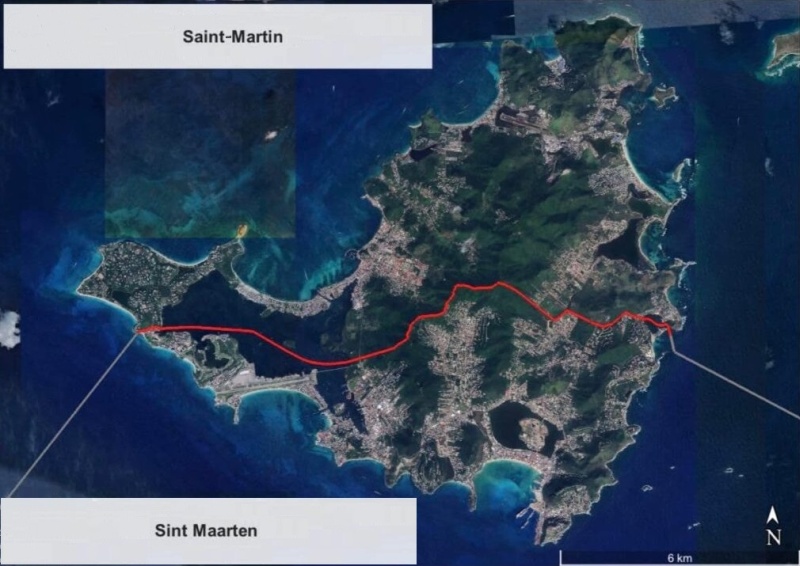
Map showing the land border (red) as agreed in 2023 and the maritime border (grey) as agreed in 2016. |
May 26, 2023: After several years of negotiations, an agreement to establish the precise route of the land border between Saint-Martin and Sint Maarten is signed at the border by Sint Maarten prime minister Silveria Jacobs and French minister of interior and overseas territories Gérald Darmanin. The border along the road leading to Oyster Pond and along Marigot Hill Road will shift north in favour of the Dutch, while along the road in Belle Plaine it will shift west in favour of the French; Oyster Pond will be shared on the principle of equidistance.
June 8, 2024: In elections to the European Parliament, local turnout is 15.4%. The list Besoin d'Europe (presidential majority) wins 33.8% of the vote, the National Front list 24.6%, and the list La France fière (supported by Éric Zemmour) 8.3%.
Jan. 9, 2025: A decree is published making Saint-Barthélemy and Saint-Martin into a full-fledged prefecture no longer dependent on Guadeloupe. This becomes effective on February 10 when Cyrille Le Vély (appointed January 15) takes office as prefect.
July 16, 2026: The French National Assembly approves the border agreement signed with the Netherlands in 2023. The law is enacted on July 22. The Dutch bill is still before the Second Chamber.