Rulers: Sint Eustatius: History
Sint Eustatius
The island of Sint Eustatius, colloquially Statia, lies in the northeastern Caribbean Sea. With nearby Saba and Sint Maarten, it comprises the Dutch Windward Islands, which however are part of the Leeward Islands group of the Lesser Antilles. (See introduction to Bonaire about the terminology.) The island's landscape is dominated by the Quill, a dormant volcano whose last eruption is dated to about 400 CE.
In pre-colonial times Sint Eustatius was inhabited by Carib Indians, though this must have been a fluctuating population for lack of a permanent water supply. Research has brought to light Indian dwelling-places in what is called the Cultuurvlakte (Cultivation Plain) - the low central plateau. The name of the island (appearing on a 1523 map as Estasia, on one of 1556 as Estaxia) presumably has its origin in sound-imitation of an Indian word whose meaning is unknown (though the Carib name was Aloi, "cashew island"). Originally, therefore, there was no connection with St. Eustatius, a martyr from the Roman emperor Hadrian's time. But saints' names were popular for naming, so both St. Anastasia and St. Eustatius were initially used, the latter eventually prevailing (in English the form "St. Eustatia" also appeared often in the 18th and 19th centuries).
Nov. 13 or 14, 1493: Christopher Columbus is the first European to sail past the island. Though the island lies within the Spanish domain, the Spaniards do not settle it any more than the other northern Lesser Antilles.
Nov. 5, 1595: The first mention of Sint Eustatius, in the account of the travels of Sir Francis Drake and Sir John Hawkins, describes these seafarers as being near the island ("Estazia") on this day.
1625: An English attempt to colonize Sint Eustatius from St. Kitts fails.
1629: The French (under François de Rotondy, sieur de Cahuzac) occupy Sint Eustatius and build a little fort there, but they soon abandon the island again due to lack of water.
April 25, 1636: The Dutch seeking a foothold in the northern Caribbean (and an earlier attempt on Sint Maarten having been reversed by the Spanish in 1633), a party from Zeeland (first going for St. Croix, but finding the English already there) takes possession of Sint Eustatius, now named Nieuw Zeeland, although that name does not stick. They find the remnants of the French fort and rebuild it, naming it Fort Oranje; 16 cannons are subsequently mounted there. Tobacco plantations are started on the island; the first tobacco crop reaches Vlissingen as early as July 1638. The island serves the same role for the Dutch as St. Kitts for the English: from here many other islands are settled, including Saba (1640), Sint Maarten again (1648), and others which do not remain Dutch, such as Tortola, Jost Van Dyke, and Virgin Gorda (modern British Virgin Islands). Contrary to Curaçao, which is administered direct by the Dutch West India Company, Sint Eustatius is entrusted by them to a "patron." The company has the status of a liege lord, the patron being its vassal. The patron (originally Jan Snouck) appoints a commander to rule over the colonists.
1643: The Spanish War Council writes to the king that the Lesser Antilles "are strewn with French, English, and Dutch, who can mobilize 30,000 armed men" (an exaggerated figure), and who, "once they gain control of these islands, will certainly take over the entire area." However, no Spanish action is ever taken against the Dutch in Sint Eustatius.
c. 1650: A clergyman travelling in the area estimates the population of Sint Eustatius as 1,600. Tobacco and cotton are grown, using Indian slaves captured in the area when running out of labour. After this time, however, the trade in black slaves develops and the island, besides Curaçao and Jamaica, becomes one of the most important slave markets in the region.
1664: English rear admiral Robert Holmes plunders Sint Eustatius.
July 23, 1665: English buccaneers take over the island. All residents are required to swear an oath of allegiance to the English king. The 61 English, Scots, and Irish living on the island take it; of the Dutch, only 19, including women and children. These 80 are permitted to remain on the island. The remainder, 76 men, 42 women, and 132 children, are stripped of all their possessions and deported to Sint Maarten, from where they are later dispersed as labourers across the plantations of Barbados. Besides these 330 whites, there are 840 black and Indian slaves on Sint Eustatius, who are taken as booty, including to plantations on the English islands. It appears that the English change the island's name to New Dunkirk. The new status proves temporary, however. As it becomes a settled practice of the nations engaged in European wars to attempt an invasion of their respective - invariably badly defended - West Indian possessions, Sint Eustatius takes the lead in this respect and, after becoming English, becomes in November 1666 French (350 English, including 150 soldiers, being taken to Jamaica and the French thoroughly plundering the island), in 1667 Dutch (restored peacefully), in 1672 English once more, in 1673 Dutch and ten days after English again, in 1682 Dutch, in 1689 French, in 1690 English, and in 1696 Dutch (see below about these changes), and continues so until 1781, with some days' intervals of French occupation in 1709 and 1713.
Late June 1672: Col. William Stapleton, governor of the British Leeward Islands, appears before Sint Eustatius. The 80 Dutchmen on the island withdraw from the obedience to Commander Lucas Jacobsen and force him to surrender the island to the English. However, Stapleton has barely landed and the surrender has not been signed when a second claimant appears on the roadstead in the person of Claude de Roux de Saint-Laurent, the French governor of Saint-Christophe (St. Kitts). The Statians, faced with the choice of whom to surrender to, choose Stapleton. 120 soldiers are stationed on the island.
June 8 (May 29, O.S.), 1673: Twelve Dutch warships (under Cornelis Evertsen and Jacob Binckes) anchor off Sint Eustatius. The English commander initially refuses to surrender, so the ships fire on the fort and the garrison soon flees; 600 landing troops go ashore and the commander surrenders. It turns out 200 men were under arms and the Dutch fought on the English side. A council of war is held against these Dutch, who argue that they feared being killed by the English if they did not fight. Their excuses are deemed insufficient; their slaves and sugar are confiscated and they are sent to Curaçao. Jacobsen himself is acquitted. 160 Englishmen are transported to St. Kitts. Sint Eustatius is made uninhabitable and abandoned after about 10 days. Immediately both English and French ships head for the island; the English win and set foot on shore again four hours before the arrival of the French.
Feb. 19, 1674 (Feb. 9, 1673, O.S.): The Second Peace of Westminster restores the territorial status quo ante, so that the Dutch right to Sint Eustatius is recognized. However, in the spring the renowned Zeeland privateer Jan Erasmus Reining decides to attack the island because of the unpleasant treatment which, he heard, the inhabitants have had to endure from Commander Peter Battery. When Battery tells him that peace has been concluded and he has been ordered to surrender the island to the Dutch, provided they are in sufficient numbers to repel a possible French attack, Reining, who lacks the necessary troops, apologizes and leaves. Due to the French threat, no transfer takes place until after the Peace of Nijmegen of Aug. 10, 1678, which ends the war between French and Dutch. Even then the English delay restitution, and another complication concerns the colony's patrons, the previous incumbents (Pieter van Rhee and Abraham van Pere) having died. Restoration finally occurs in early 1682, the rights having ended up half in the hands of the Dutch West India Company itself, half in those of Isaac van Pere. On July 26, 1683, the latter also transfers his half of the rights to the company. Sint Eustatius and Saba thus ceases to be a patronal colony.
1685: After the revocation of the Edict of Nantes, the company, at the behest of the Estates-General, admits French Huguenot refugees to the islands.
1686: The kings of England and France conclude an agreement, valid for all their West Indian possessions, prohibiting privateering on each other's ships and maintaining peace in the region in the event of disputes between the mother countries. However, this does not hold when war breaks out again in 1689.
Oct. 6, 1686: Louis Houtcooper, the commander since April 1682, having already obtained his discharge, dies before the arrival of a successor. On December 13 Lucas Schorer, 29, is appointed as his successor. An administrative instruction of that date stipulates that next to the commander there will be a Council, composed of six of the most capable and most qualified inhabitants of Sint Eustatius and Saba, appointed by the commander from persons proposed by the citizens.
Aug. 24, 1688: Schorer reports that the garrison of Sint Eustatius consists of five soldiers and a corporal. The danger of an understaffing becomes clear that same month when a slave revolt occurs which, however, is suppressed after one ringleader was shot dead.
April 6, 1689: The French (under Charles de Courbon, comte de Blénac) conquer the island. Commander Schorer, being allowed under the terms of surrender to depart to Nevis, later takes refuge on Saba, which managed to beat off the French. Although the Sabans, resenting their dependency relation to Sint Eustatius, earlier abjured him, he is now received as their lawful commander, founds a kind of administration-in-exile, and in 1690 raises an army of liberation 35 men strong. During the night of July 25/26, 1690, this force (Schorer staying behind) lands in Jenkins Bay1 and pitches camp within sight of Fort Oranje, defended by 40 French soldiers. On July 28 Schorer lands with 16 volunteers. At this stage, however, the liberators see six English vessels rounding the corner of Tumble Down Dick Bay2 - Englishmen who also seek to conquer Sint Eustatius. The English, 350 in number, likewise make an encampment. England and the Dutch republic being currently allied in Europe, Schorer withdraws in due course, and the English take over, Sir Timothy Thornhill becoming governor. Those who fled the French are allowed to return.
1 This bay was given this name only later, after a man who was said to have been so poor when he came to the island that he had to sleep under the boat in which he came, but who became so rich during the island's golden era that he minted his own coins - depicting a man sleeping under a canoe.
2 The name of this bay is explained by a legend that a certain Dick, who was mixed up in some way or other with smuggling, fell to his death while climbing the steep coast so that people started talking of Tumble Down Dick (an epithet that has also been applied to Richard Cromwell, lord protector of England in 1658-59). This became in Dutch "Tommelendijk" according to its sound. However, it has also been explained the other way around, although the Dutch term has no discernible meaning.
1691: King William III orders Sint Eustatius to be returned to the Dutch. In 1693 civil authority is turned over to one of the Dutch residents, Johannes Salomonsz. But only in 1696 does the commander of the English occupying force, Maj. William Mussenden, receive the order to surrender the island to Gilles Pietersz. (That Schorer was not appointed to take over may find its explanation in a letter written in 1694 by some residents of Sint Eustatius, in which they declared the former commander "incapable," "not in his right mind and not in command of his senses.") But the company, though by its charter instructed to appoint "chiefs" itself, this time gives permission to the people to elect a commander; on May 31, 1696, with 36 of 59 votes, Salomonsz defeats Jan Simonsz Doncker. At the Peace of Ryswick (Sept. 20, 1697) the Dutch right to the island is formally acknowledged.
1699: Population: 784, including 399 free inhabitants and 385 slaves.
Aug. 10, 1700: Commander Salomonsz dies. The merchant Lucas van Beverhoudt then demands another election and with some followers briefly occupies Fort Oranje. However it is Doncker, the captain of the citizenry (kapitein der burgerij), who as second in command assumes the interim, although his application for the permanent position is not accepted, and on July 18, 1701, Isaac Lamont (who belongs to van Beverhoudt's party) becomes commander.
Aug. 7, 1701: Commander Lamont announces measures requiring vacant plantations to be repossessed within three years. The war events produced after 1689 a considerable exodus of Statians to St. Thomas, a Danish island which is very much under Dutch influence; they took their belongings and slaves with them but did not relinquish their land.
1703: Sint Maarten is added to the colony, headquarters remaining on Sint Eustatius.
Dec. 17, 1703: Lamont, having requested resignation as several people lodged complaints about him, is relieved of his position. He leaves in June 1704. Doncker is appointed commander, taking office in November.
Dec. 3, 1707: The company establishes the rank of premier commander, next to a second commander.
July 1709: Lamont, having been rehabilitated, returns as (premier) commander, with Doncker as second commander, whom Lamont calls "completely insane."
Nov. 25-Dec. 1, 1709: French filibusters, landing at Tumble Down Dick Bay, hacking their way to the top, and occupying Fort Oranje, carry away almost all the merchandise besides 264 out of the 463 slaves present.
Dec. 6, 1709: Lamont leaves Sint Eustatius again. Doncker succeeds.
Jan. 24, 1713: French privateer Jacques Cassard arrives at the defenseless island, which has to reach an agreement the next day. Cassard repeats the feat of 1709, departing on January 27 with a bill of exchange for 3,400 pesos (fl. 8,260), 22 cattle, 65 sheep, 6 goats, 23 turkeys, and 67 chickens.
April 13, 1713: The Peace of Utrecht ends the War of the Spanish Succession, and the resulting peace in the Caribbean prompts many to return to ravaged Sint Eustatius, which reaches a population of 1,274 (including 750 slaves) in 1715 (more than twice the figure of 1705), in which year 11 sugar plantations are already in operation again.
1717: Statians turn to the Estates-General of the Netherlands with the request to be allowed to colonize St. Croix (which was in Dutch hands in 1643-46 and abandoned by the French in 1695) again, but an answer is never received (St. Croix becomes Danish in 1733).
1717: Gerard de Mepsche arrives as second commander to Doncker. According to Doncker, he pursues drink from morning to night, and after Doncker's death (August 21) things go from bad to worse, so that the council dismisses de Mepsche in October. The citizen captain, Johan Heyliger, assumes command for two years until Jacob Stalpert arrives in November 1719.
Nov. 3, 1720: Stalpert dies and four people simultaneously seek the commandership: Jan Stalpert, a brother of the deceased; the well-known civilian captain Johan Heyliger; the secretary Johan Lindesay, a son-in-law of the late Doncker; and Jan de Windt, who came over from Sint Maarten. A fifth, Jacobus Stevens, is ultimately appointed, with Jan Stalpert as second commander.
Dec. 18, 1722: Stevens dies, like Stalpert having served just about a year. Lindesay then provisionally becomes commander, and stays in office for almost 6 years although corruption and other complaints abound. He builds a new church, a prison, and a slave house.
July 1728: Everard Raecx arrives as new commander, with instructions to investigate the abuses under Lindesay. He begins by deposing Jan S. Doncker, Jr., as citizen captain and soon also sends a certain Laurent Isnard to the French islands to collect the money from the company goods sold by Lindesay, a total of 60,000 pesos. Isnard never returns. Lindesay, together with Doncker Jr. and the deceased Stevens - all three were brothers-in-law - ruled Sint Eustatius as a kind of triumvirate, says the fiscaal Johan Meyer. The arrival of Raecx enraging the remaining two, they go "underground" and hatch a kind of conspiracy, the conspirators being called "Black Badgers." At one point, Raecx has Lindesay imprisoned, but he manages to escape to St. Kitts. By selling the significant real estate left behind by Lindesay, the company recoups at least a third of the debt.
Feb. 10, 1733: Commander Raecx dies. He is succeeded in 1734 by Johan Heyliger.
March 10, 1736: Commander Heyliger dies. He is succeeded in 1737 by Swiss-born Isaac Faesch.
c. 1739: A synagogue is built. (A population list of 1722 showed 21 Jews out of 1,204 residents, but more probably arrived around 1730.) It is renovated after 1773, and there are 157 Jews on the island in 1790, but after 1795 the Jews gradually disappear, there being only 5 in 1818 (the last of these, Anna Vieira de Molina, dies in 1846).
c. 1740: Tobacco, cotton, and coffee mostly vanish from the island as sugarcane seems more profitable.
July 1740: Commander Faesch is appointed director of Curaçao and is succeeded by Hendrik Coesvelt.
Sept. 11, 1740: A hurricane ravages the islands.
Aug. 20, 1741: Commander Coesvelt dies. Jasper Ellis becomes acting commander.
1742: Population: 2,446 (860 whites, 1,586 slaves).
June 22, 1743: Johannes Heyliger Pzn. becomes commander. He lays the foundation for the island's prosperity.
1747: The number of white inhabitants is 1,002 (up from 517 in 1735). This year all available land is brought under cultivation.
1748: Fort Hollandia is built for the protection of merchants who began building warehouses at Orange Bay.
1750: Sint Eustatius suffers damages of more than one million guilders by British reprisals against Dutch vessels. The fact that such a loss can be tolerated demonstrates the magnitude of the profits the island makes as a trade centre, contrary to British interests.
1750: Population: 2,315, including 1,513 slaves.
Nov. 21, 1752: Commander Heyliger dies. His successor, Jan de Windt, Jr., serves for 22 years (1753-75). A man of decorum, he presides not just over increasing prosperity but also a more dignified cachet of island life in general. He also continues the construction of a ring of small forts - unbroken but for some inaccessible points - around the island. Most of them, however, are not forts properly speaking, but field-works, for there is a lack of soldiers to man them, and resistance to landing parties proves to be ineffective.
1756: Commander de Windt takes the wind out of the sails of the island's only major trade competitor, Danish St. Thomas, by abolishing the 1% import duty.
1757: A schoolmaster, Lukas Soet, arrives from Amsterdam. He soon has a large school and is still on the island in 1781.
c. 1760: Partly owing to a lack of accommodation in the town proper, partly also to facilitate business with the shipmasters arriving there, the inhabitants begin to settle on the Bay, where there were only warehouses previously. Thus arises what comes to be called Lower Town. Lower Town (Benedendorp) and Upper Town (Bovendorp) together later come to be called Oranjestad, though when exactly that name is adopted is obscure (Oranje as name of the town appears as early as 1837, the English form Orange Town does so as early as 1861, later written Orangetown, but it seems to be only from about 1870 that references appear to Oranjestad - which happens to be the same name that previously was adopted by the capital of Aruba).
1760: The island is effectively blockaded by the British. Trade comes to a standstill. Under the influence of the Spanish-British hostilities in 1766-67, it flourishes again.
1763: De Windt sends two armed barques to help quell a slave revolt in Berbice (in modern Guyana).
1768: Sint Eustatius produces no more than 600,000 (Amsterdam) pounds of sugar, but it ships about 9 million pounds. This through-trade of sugar from British and French islands gives more profit than the slave trade. The figure rises to 13½ million pounds in 1770 and 25 million in 1779, almost wholly to North America. In 1778 more than 3,500 merchant vessels call on the island whose population includes Greek merchants and a strong Jewish colony (Honen Dalim). The island becomes so prosperous that it comes to be nicknamed Golden Rock or Diamond Rock. On Sept. 20, 1779, the council can write that "this place has become a refuge and general storehouse and larder for the peoples at war in these regions."
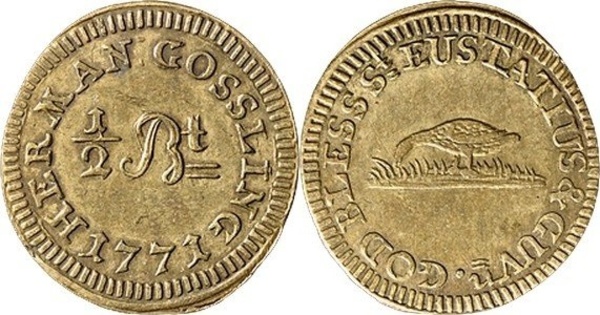
Herman Gossling's ½-bit coin, 1771. |
1771: Wealthy merchant Herman Gossling has small brass coins minted. The obverse side features a gosling and the inscription "God bless St. Eustatius & Guvn." (i.e., governor, as the commander is sometimes addressed), and the reverse side features the denomination 1 (or ½) Bt. (bit - the local name for the Spanish silver real, which circulates widely in the West Indies), with the inscription "Herman Gossling."
Aug. 31, 1772: A hurricane causes widespread devastation. Except for the church, everything is rebuilt within a year.
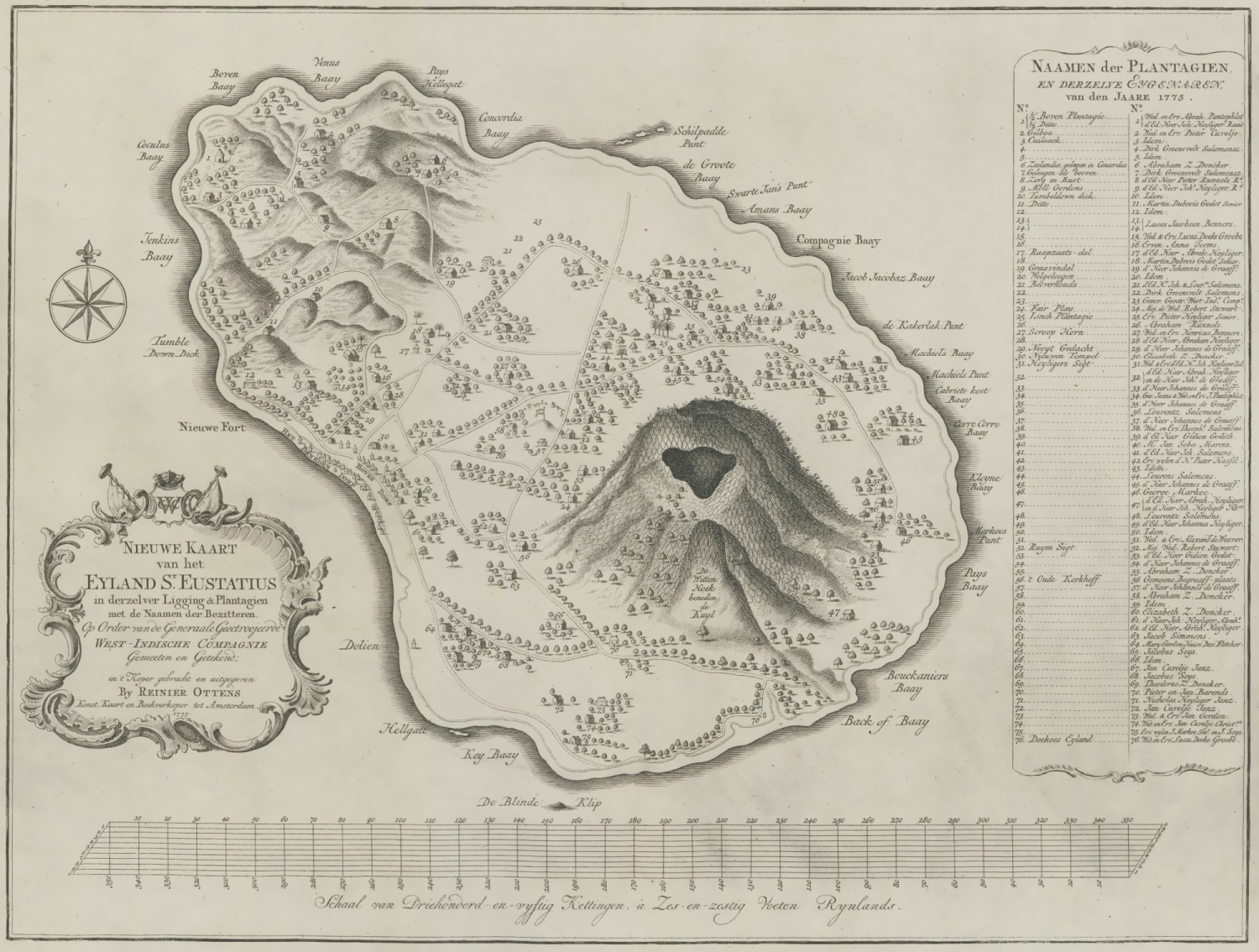
Dutch map of Sint Eustatius, 1775, showing owners of plantations. |
Jan. 19, 1775: Commander de Windt dies. Three candidates then seek the office: Abraham Heyliger, vice commander of Sint Maarten and now acting commander of Sint Eustatius; Johannes de Graaff, who has been the island's secretary for 24 years; and Johannes Salomonsz Gibbes, originally Swedish and a council member on Sint Maarten. On April 29, 1776, the stadholder appoints de Graaff. He is succeeded as secretary by Alexander le Jeune, who later complains about corruption and other abuses by de Graaff. De Graaff, with the cooperation of the council, suspends le Jeune and travels to the Netherlands to explain the situation; in the usual compromise, le Jeune has to apologize to the council but the commander is ordered to reinstate him in his position, with compensation.
December 1775: The Continental Congress appoints a secret American envoy in The Hague, Charles W.F. Dumas. Some of Benjamin Franklin's correspondence with Dumas runs via Sint Eustatius.
1775 or early 1776: After three churches were destroyed by hurricanes, a stronger Reformed church is completed. It withstands the attacks of the hurricanes, and also the decline of its parish; its incumbent departs in 1795 and it is used rarely since.
Nov. 16, 1776: A ship of the new Continental Navy, the Andrew Doria, flying the Grand Union Flag, appears in Sint Eustatius roadstead and has her flag and gun salutes acknowledged by counter-salutes. Although this cannot be construed as a formal recognition of sovereignty, it creates tensions between Dutch and British. The latter were already envious of the island because of the fact that the sugar from the British islands eluded their monopoly via Sint Eustatius, and their resentment was aggravated when, after the outbreak of the American war of independence, Sint Eustatius traders laid in stocks of arms, and especially gunpowder (yielding high profit margins), in addition to their usual range of merchandise. Although this was banned by the Estates-General, the ban, while repeatedly renewed, is not enforced. In 1777, on a British complaint about these matters, the Estates-General announces it will call Commander de Graaff to account and disavows his actions insofar as they could suggest recognition of the independence of the United States, and with this the British government is satisfied.
1779: Population: 3,056, including 1,563 slaves.
Feb. 23, 1779: De Graaff submits a lengthy report to the directors of the Dutch West India Company, defending his conduct. His justifications are accepted and he returns as commander.
Oct. 12, 1780: A hurricane destroys many houses and hundreds of people are killed. Considerable damage is caused to the coffee and cotton plantations.
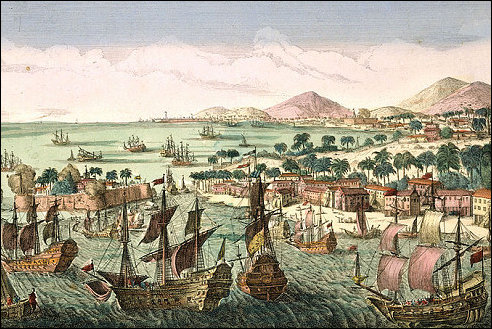
The British seizure of Sint Eustatius, 1781, depicted in an engraving by Johann Baptist Bergmüller. |
Feb. 3, 1781: The fourth Anglo-Dutch war having broken out in December 1780, the British admiral George Bridges Rodney seizes Sint Eustatius, which quickly surrenders. By letting the Dutch flag fly for over a month, he succeeds in trapping 150 ships, with some 40 more off Saba and Sint Maarten. Rodney decides to stay until "the Lower Town, that nest of vipers which preyed upon the vitals of Great Britain, be destroyed." British sentries are posted every 15 paces throughout the town, embarkation and disembarkation are prohibited, a curfew is imposed at 8 PM, and the pockets and clothing of the inhabitants are often searched with gross indiscretions; the Jews are treated especially harshly. Rodney's booty amounts to an estimated £3-4 million. When conveyed to England, however, much of it falls into the hands of Frenchmen and Dutchmen off Brest.
May 4, 1781: Rodney leaves the island, leaving Brig.Gen. David Ogilvy as governor, who dies already on May 31 and is succeeded by Lt.Col. James Cockburn.
Nov. 25, 1781: The British are driven off the island by a French surprise attack led by François Claude Amour du Chariol, marquis de Bouillé, the governor of Martinique. (In 1783 Cockburn is court-martialled for the loss of the island and is dismissed from the army.) Charles Chabert, a native of Sint Eustatius, is appointed as civil governor, with Thomas de Fitz-Maurice as military commander. A proclamation says that France has taken possession of the colony for the Estates-General of the United Netherlands and that the islands will remain occupied by French troops until an arrangement is reached with the Netherlands. The French build a fortress on the mountain ridge called Panga (between Pilot Hill and Signal Hill). The owners of lands where fortifications lie have to construct roads over their grounds by which these forts can be reached, at their own expense.
1784: Free trade in slaves is no longer permitted. The consequences of this extend far beyond the slave trade, because it was always accompanied by the trade in sugar and goods.
Feb. 7, 1784: The island becomes Dutch again. The oldest council member, Olivier Oyen, provisionally assumes the government. It is decided to maintain the title of governor instead of commander; on Feb. 3, 1785, Abraham Heyliger assumes the post. Meanwhile, many who fled after Rodney's raid gradually return, and prosperity is soon regained.
Aug. 24-25, 1785: During a storm, the government building is destroyed and Governor Heyliger is injured in the hand.
Dec. 2, 1785: Heyliger dies and the citizen captain, Johannes Runnels, becomes acting governor.
1786: A slave named Black Harry, who became a Methodist elsewhere, transplants Methodism to Sint Eustatius, forming a group whose followers are called the Jumpers, because their meetings often lead to revivals with ecstasies and convulsions. In January 1787 Runnels forbids Harry from preaching after 16 people fell into a state of ecstasy for hours during a meeting. Only at the intercession of the fiscaal, who finds no motive for flogging, does Harry escape this corporal punishment. Later that month, however, the Methodist church regularly establishes itself on Sint Eustatius, when Bishop Thomas Coke visits, distances himself from Harry, and is granted a preaching permit (but afterwards does join forces with Harry before leaving in February). The church uses English as its vehicle. By this time the Dutch language plays only a minor role on the island. A number of Dutch words have been anglicized, e.g. dwile (floorcloth, originally dweil), stiver (a 5-cent coin, originally stuiver), to metsel (to mason) a grave. In 1788 Harry takes things too far again and he is flogged and then sold or banished to North America (where Coke later finds him as a freedman and zealous preacher). On New Year's Eve 1788 Coke lands again for a brief visit and records that the Methodist congregation already numbers 258 souls. After being shipwrecked he has to return, sees this as a decree of God, and decides to stay; but ultimately Runnels informs him that he is no longer allowed to preach, and he leaves again.
1787: The steep road between the Upper and Lower Town, the so-called Bay-Path, is paved.
1789: A weekly newspaper, The St. Eustatius Gazette, is established. It is entirely in English, except for some Dutch advertisements. The first newspaper in all the Dutch Antilles, it lasts until about 1793.
June 29, 1789: Pieter Anthony Godin takes office as governor. With his irascible nature, it does not take long for the Statian community to wish for his departure.
1790: Population reaches a peak of 8,124 (of whom 2,341 are whites, 5,140 slaves, and 643 free people of colour).
End of 1791: The Dutch West India Company ceases to exist. The colony comes under the direct supervision of the Dutch government, but this change makes no difference locally.
April 7-13, 1792: A cloudburst washes small houses away in the Upper Town, and in the Lower sweeps several people out into the sea; one of them dies.
June 3, 1792: Godin departs and Runnels again becomes acting governor.
1795: As the Dutch republic becomes a satellite of France, the islands come under French rule. The French eaxct initially fl. 50,000 a month, which given the small population (1,200 white inhabitants on Sint Maarten, 2,400 on Sint Eustatius, a few hundred on Saba) cannot be scraped together and is gradually lowered. With the through-trade no longer serving a useful purpose and the slave trade dying fast, prosperity goes rapidly downhill. By 1801 the total population of Sint Eustatius is a mere 2,500.
July 12, 1795: Runnels is suspended for allegedly being pro-stadholder and pro-English and is provisionally replaced by Daniël Roda with the title captain-commandant. The residents approve the new form of government on August 24.
19th century: St. Eustatius is proclaimed patron saint of the island.
April 16, 1801: The British having already seized Sint Maarten in March, Col. Richard Blunt, commander of the troops, and John Perkins, commander of the British warship Arab, attack Sint Eustatius. The French resist but are driven off. On April 21 Roda signs a surrender document, also for Saba. Blunt is initially the British commandant, being replaced in 1802 by Maj. John Wardlaw.
Nov. 21, 1802: The British return the island to the Dutch pursuant to the Treaty of Amiens of March 27, 1802. The Dutch Windward Islands are divided into two colonies: Sint Maarten and Saba together, and Sint Eustatius, each with a governor, for Sint Eustatius Albertus van Heyningen, Jr.
May 1803: The rift between England and France collapses the economic recovery that followed the restitution - Sint Eustatius again received products from the French Antilles, North America, and Europe and served as a warehouse where these goods were exchanged. In 1808 the U.S. imposes an embargo prohibiting trade to and from American ports.
July 2, 1806: The Dutch Council of the American Colonies sends a memorandum to King Lodewijk I Napoleon saying that Sint Eustatius costs fl. 50,000 per year and except for transit trade in peacetime - because it "is not susceptible to defense" - is actually of no use.
May 1809: Due to administrative irregularities in the administration of the ailing van Heyningen (who dies in August), the governor of Sint Maarten, Jan Verveer Jzn., is also charged with the administration of Sint Eustatius, and it is determined that he will live there, but this is apparently delayed and the chairman of the council, William Charles Mussenden, comes to administer the island.
Feb. 21, 1810: The British again take over Sint Eustatius. Maj.Gen. Thomas Barrow becomes governor.
1816: Population: 2,668, including 507 whites, 1,748 slaves, and 336 free people of colour.
Feb. 1, 1816: The island is finally confirmed as Dutch territory. The Dutch Windward Islands become a single colony again, under a governor based on Sint Eustatius. Reinier 't Hoen becomes acting governor at first. A garrison of officially 24 men is stationed on Sint Eustatius.
1817: As revenue from the existing family tax, levied on each head of the family, proves insufficient, a 2% tax on the sale of real estate is introduced.
June 2, 1817: Abraham de Veer takes office as governor.
1819: Only six people on the island know Dutch at this time.
September 1819: Fort Panga is destroyed by a hurricane. It is not repaired.
Jan. 15, 1821: The combined commandership of Sint Maarten and Saba is abolished. Saba is placed directly under the governor's authority and thus rejoins Sint Eustatius.
March 28, 1821: The history of the Anglican church on Sint Eustatius ends somewhat abruptly when Pastor John Audam announces that he will be leaving for health reasons.
1822: The ports of the British islands are opened to North American ships, thus destroying Sint Eustatius's trade. In 1826 the ports are closed again, bringing some revival to Sint Eustatius, but before it can truly flourish, the United States and Sweden conclude a trade treaty in 1827, resulting in trade shifting to the Swedish island of St. Barthélemy, with its beautiful harbour, Gustavia.
March 6, 1823: Wilhelm August van Spengler takes office as governor.
Jan. 7, 1827: By papal decree the Dutch Windward and Leeward Islands are united under canon law into a single prefecture, governed by the apostolic prefect of Curaçao. At this time there is no Catholic priest on the Windward Islands.
March 23, 1828: Johannes van den Bosch, commissioner-general for uniting the Dutch West Indian colonies, arrives in Sint Eustatius. He removes van Spengler (who has been accused of admitting and favouring privateers) and replaces him with Willem Johan Leendert van Raders, with the title of commander, taking office April 1. At a meeting held on March 28 with residents and landowners, van den Bosch announces that the king does not desire any income from the colony, but only wants it to bear its own administrative costs. His alternative is that the money should come either through trade duties or as a property tax. The residents choose the latter, and a 1% levy is imposed. The port of Sint Eustatius is declared free for all friendly nations, effective April 1. Van den Bosch departs on April 3. The free port, which is hoped to lure trade to the island, proves of no avail, and British naval action soon puts an end to privateering. The king is forced to subsidize, and by decree of June 13, a system of taxes is introduced, including a 1% tonnage tax on imported goods.
May 1828: The first steamship, the Curaçao, arrives in Sint Eustatius.
July 21, 1828: The Dutch Caribbean islands and Dutch Guiana (Suriname) are united as Dutch West Indies, consisting of four sub-colonies: Sint Eustatius (with Saba), Sint Maarten, Curaçao (with Aruba and Bonaire), and Suriname, with a governor-general in Suriname, effective August 1. A Municipal Council (Gemeenteraad) replaces the Political Council (Raad van Policie) on April 1, 1829.
Aug. 26, 1829: A storm causes an unfinished cofferdam (another plan of van den Bosch) to crack and collapse.
c. 1830: A general exodus begins, notably to New Orleans, though this is dangerous for those not entirely white, as even lighter-skinned people of colour run the risk of being arrested and sold as a slave there.
Nov. 20, 1833: The title of commander is changed to administrator (gezaghebber). The Municipal Council disappears. A Colonial Council (Koloniale Raad) is established for Sint Eustatius including Saba. It consists of six members, who may not be civil servants; they are appointed by the governor-general from a list made up by the council itself.
July 18-19, 1835: Prince Willem Frederik Hendrik, son of the future King Willem II, visits Sint Eustatius.
Jan. 11, 1836: Administrator Raders is granted nine months' sick leave, but dies already on January 25. Theophilus George Groebe is sworn in as acting administrator. The governor-general, however, appoints the colonial secretary of Sint Eustatius, Philip D.F.M. Spiro, to assume the interim; when the minister of colonies, van den Bosch, points out to the king that according to the government regulations of Sint Eustatius, the longest-serving member of the Colonial Council present (Groebe) should have been appointed, and not someone like Spiro, who, moreover, "became insane to a very high degree during 1834," the king authorizes van den Bosch to instruct the governor-general to entrust Groebe with the position. When it comes to the filling of the regular position, Groebe is considered, but does not desire the position and supports an application by Spiro. On the recommendation of the governor-general, however, the king on April 4, 1837, appoints Johannes de Veer, who takes office July 15.
April 27, 1836: The apostolic prefect of Curaçao, Martinus Johannes Niewindt, accompanied by the priest Manuel Romero, arrives in Sint Eustatius. Groebe receives them rather coolly, claiming there are only four Catholics on the island. The number turns out to be somewhat larger; in a later letter, Niewindt states that "we soon discovered about 70." They remain until May 31. It was a disappointing stay as neither spoke English. In 1841 Niewindt appoints J.F.A. Kistemaker as pastor of Sint Eustatius. In 1843 Kistemaker appeals to Groebe (temporarily again acting as administrator), requesting that measures be taken because order is being disturbed, as Rev. William Satchell of the Methodist congregation instituted a weekly "anti-Roman church service" on Tuesdays. Satchell, questioned by Groebe, says he does not incite his people against the Catholics and only considers the introduction of Catholicism on Sint Eustatius wrong, because the system is "corrupt and soul-destroying" and the "Church of Rome in her nature and tendency blasphemously wicked." The matter is sent to the governor-general in Paramaribo, who rules in Kistemaker's favour. Satchell leaves the island some time later, but the dispute is only the first in a long series in which Methodists and Catholics are fiercely opposed to each other. Kistemaker remains pastor until 1857.
Feb. 8, 1843: In a severe earthquake, the wooden Methodist chapel is destroyed. Within ten months Satchell is able to inaugurate a new (now stone) building, larger than the previous one. Fort Oranje is also largely destroyed in the earthquake; it is subsequently somewhat restored.
April 9, 1845: It is announced that the islands are to be separated from Suriname. This becomes effective July 16. The administrator of Curaçao becomes the ultimate authority for the other islands. It is argued that the Windward Islands are too insignificant to be brought in direct contact with the motherland. The language peculiarity of the Windward Islands means that everything coming from Curaçao (as from Suriname before) has to be translated.
1846: According to the colonial secretary Arnoldus Hermanus Bisschop Grevelink, the population "has had nothing in common with the Dutch for a long time and is highly hostile to them."
Jan. 27, 1848: Regulations are issued for the administration of the colony of Curaçao and Dependencies, comprising the Dutch Windward Islands and the three territories of the Dutch Leeward Islands - Aruba, Bonaire, and Curaçao. Under a governor based in Curaçao, each other island has its own administrator (gezaghebber, commonly translated as lieutenant governor). The Colonial Councils disappear and Advisory Committees are established on each island, consisting of two residents nominated by the administrator.
June 12, 1848: A large number of slaves gather in front of the administrator's house and make demands. Administrator de Veer addresses them, but to no avail, and finally appeals to the militia. The revolt is suppressed when the ringleader and a few of his supporters are mortally wounded. A warship is sent from Curaçao, which arrives on June 21. A garrison of 30 men is then again stationed on Sint Eustatius. Some troublemakers are transported to Curaçao.
Second half of 19th century: The economy continues to decline. Of 30 houses still standing in the Lower Town as late as 1840, only 10 are left in 1900, and of these only 5 are inhabited. Buildings are demolished to sell the bricks, as the beautiful Dutch clinkers fetch a good price in the region. Some little profit is made by sugar-growing (in 1856 still amounting in value to fl. 70,000), but it is the islanders who leave their islands that earn most: as seasonal labourers on the sugar estates of Cuba or Puerto Rico, or in the phosphate mines of French Guiana. After 1830 the rise of sugar-beet growing in Europe and the cultivation of sugarcane in Java meant keen competition for the small individual planters of Sint Eustatius, and the abolition of slavery in 1863 becomes an added drawback.
Dec. 15, 1853: Administrator de Veer is discharged on his request for health reasons and Willem Hendrik Johan van Idsinga is appointed in his place; he takes office May 5, 1854.
1860: A public school is established.
1860: Nicolaas Albertus Rost van Tonningen is appointed administrator as van Idsinga is transferred to Sint Maarten.
Oct. 21, 1862: The slave emancipation act is promulgated on Sint Eustatius, bringing a restoration of calm after unrest resumed early in the year. The effective date is July 1, 1863, when the end of slavery is greeted with a 21-gun salute. 1,138 slaves acquire their freedom. About 250 of them leave, mostly for Danish St. Croix. The former slave owners are indemnified with fl. 200 per slave.
Nov. 20, 1865: A new government regulation is promulgated, effective Jan. 1, 1866. The Advisory Committee is replaced by a Political Council, consisting of elected members for the first time.
1866: Due to the incidence of leprosy, an institution called the Lazaretto is built at Diamond Rock (opened Feb. 4, 1867). A curious situation is that, although a supervisor was appointed, it was forgotten to budget for the patients' food.
March 20, 1868: The first elections take place. Th.G. Groebe and H.P. Pandt are elected landraden (councillors).
Dec. 1, 1869: Administrator Rost van Tonningen is discharged on health grounds. He is succeeded in 1870 by Melville Wood Cruger.
Aug. 21, 1871: A hurricane destroys all the sugar crop. In 1875 production is abandoned entirely. Later attempts to revive sugar-growing come to nothing, as it becomes plain that sugarcane growing can only be lucrative on a large acreage with the produce processed centrally.
1874: A Council of Justice is established in Sint Eustatius for this island and Saba. Originally in 1869 only one such council for the three Windward Islands, located on Sint Maarten, was established.
Jan. 1, 1877: Theophilus George Groebe (not the one of 1836-37) takes office as administrator.
Sept. 17, 1885: Administrator Groebe is transferred to Sint Maarten and is succeeded in Sint Eustatius by Jacques Joseph Jonckheer, administrator of Saba.
June 7, 1888: Paul Faarup is appointed administrator.
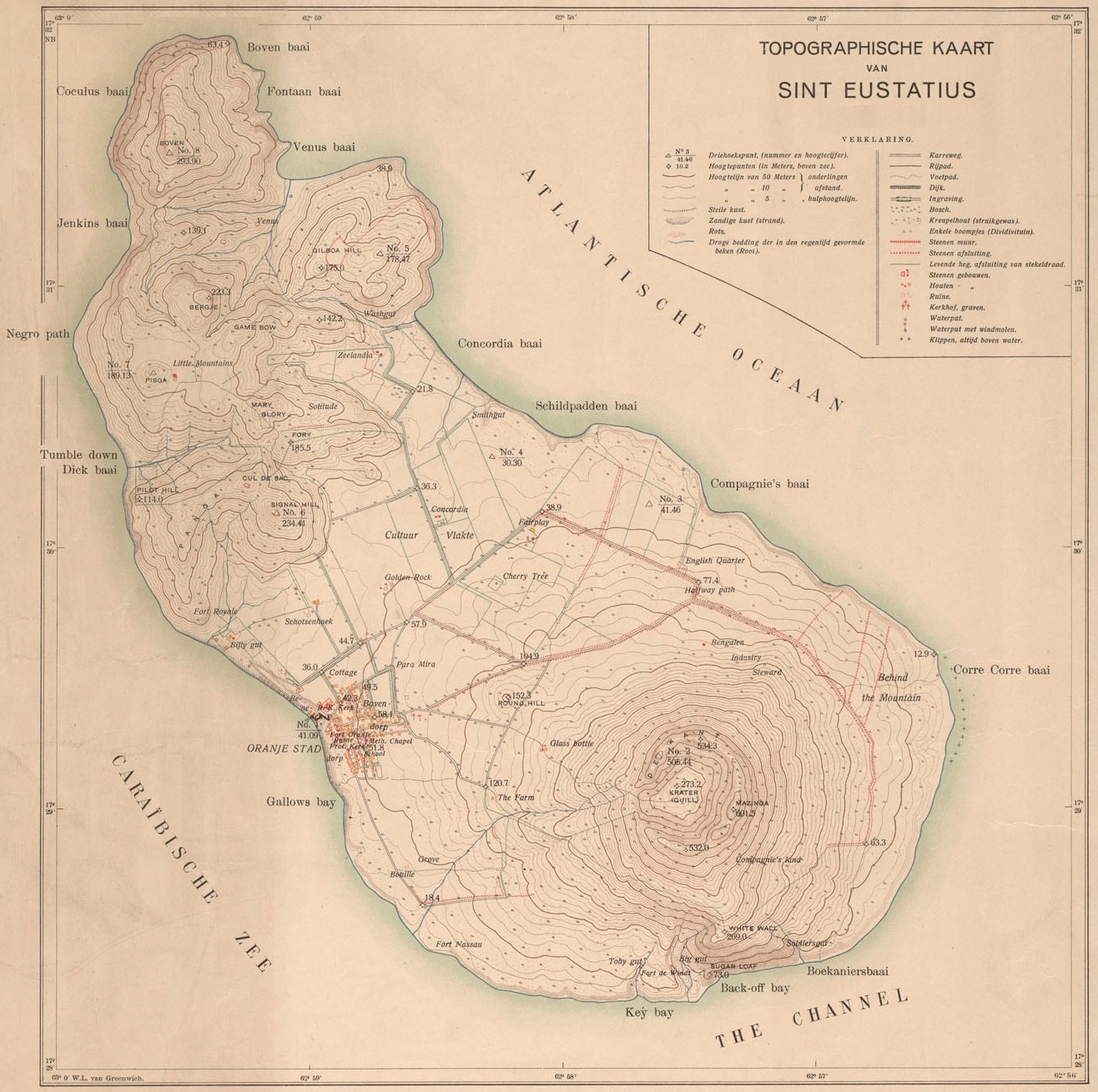
Dutch map of Sint Eustatius, c. 1890. |
Oct. 25, 1894: Abraham Jan Cornelis Brouwer is appointed administrator.
1898: Queen Wilhelmina's accession to the throne is celebrated exuberantly on Sint Eustatius. The square in Oranjestad is planted on that occasion and named Wilhelmina Square.
1899: Dominican Sisters start Roman Catholic instruction.
1902: Out of a population of over 1,300, there are approximately 100 whites, of whom 4 are European Dutch and the rest Statians.
March 21, 1902: Gerrit Johan van Grol is appointed administrator.
1903: Dutch member of parliament Henri van Kol visits Sint Eustatius and reports that the island, with "ruins on the beach, dilapidated houses and piles of rubble on the hillside, the tower without a church, and the abandoned synagogue... made a desperately deserted impression." At the top, he arrived at "a site that, according to a painted board, was supposed to represent Fort Oranje." He describes the majority of the coloured population as lacking any sense of justice and terrorizing society with practices derived from obia magic; and even among the better classes, the sense of justice is so weak that few sentences exceeding one year are handed down, as the convicted are then sent to Curaçao and the jailer misses out on the benefits associated with feeding the prisoners.
1903: Of 1,458 residents, only 50 live outside Oranjestad.
1905: The government conducts a trial of sisal cultivation. The plant performs well. In the peak year of 1921, over 200 ha of sisal are planted. In 1928 the cultivation is discontinued, both because the product can no longer be sold in the United States and due to a lack of labour. Under the zealous authority of van Grol, all sorts of crops were tried, including peanuts (1903), pineapple (1906), arrowroot (1917), and Ceará rubber (1918). Trials were also conducted with Italian honeybees in 1903-06 (the difficulty being the scarcity of flowers for a considerable period of the year).
1906: A jetty is constructed, but it quickly becomes clear that the length is insufficient. Money for an extension is not approved and it is ultimately left to the elements.
1907: Dutch naval hero Michiel de Ruyter's 300th birthday is celebrated, a simple plaque with an inscription being erected, as de Ruyter visited Sint Eustatius in 1647 and May 1665.
March 12, 1915: A tractor is imported to Sint Eustatius, the first motor vehicle.
April 5, 1918: At a meeting of the Political Council regarding food supplies, at the home of Administrator van Grol, the latter maintains that he cannot delegate responsibility assigned to him by the governor to a councillor. The councillors, J.G.C. Every and W.J.F. Mussenden, disagree. This leads to an uproar, which forces the administrator to close the meeting, which the councillors oppose. Matters get physical and the administrator is assaulted by fist. Van Grol reports the incident, which comes to trial. Since he is himself chairman of the Council of Justice, he is temporarily relieved of this position, which is assigned to a member of the Court of Justice of Curaçao. While awaiting the judge's arrival, the two councillors flee to St. Kitts, but when it becomes known that only a fine is demanded, they return. They are sentenced to fl. 400 and 300 respectively, but remain as councillors as they are irremovable in that position.
1919: Cotton exports reach a peak of 127,000 Antillean guilders.
November 1919: Curaçao governor Oscar Louis Helfrich visits Sint Eustatius. The people demonstrate their cordiality in the serenade, which includes the song "Wien Neerlands bloed" ("Those in whom Dutch blood") sung in English, followed by a beautiful song for the occasion: "Our governor is present, how happy we are."
Aug. 3, 1920: By a decree of Governor Helfrich, Sint Maarten becomes the residence of the administrator (gezaghebber) of the Windward Islands, represented on each of the other islands by a deputy administrator (plaatsvervangend gezaghebber) - according to a decree of May 1919, ex officio the ontvanger (receiver of revenue, or tax collector); Benjamin Irving Mussenden accordingly replaced van Grol in Sint Eustatius in July 1919 already. There has been a movement led by Sint Maarten councillor Josiah C. Waymouth for separation of the Windward Islands from Curaçao, but when Helfrich visits Sint Eustatius he soon notices that there is no interest for such secession there; on a wall at the deputy administrator's residence he reads: "Down with St. Martin, Curaçao for us."
Early 1920s: Emigration to the U.S. increasingly occurs, before coming to an abrupt halt with the 1924 U.S. immigration restrictions. Emigration then turns to Curaçao. By 1926 so many have left that agriculture and livestock farming suffers. Women begin to perform the work normally done by men, leading to a shortage of women's hands for the tasks usually performed by women - which are therefore left to children, but this being insufficient, an immigration arises from surrounding islands where people are often even poorer, especially Nevis and, somewhat less so, St. Kitts.
1922: The Gertrude Judson Library is founded, named after the maiden name of a lady from Chicago (Gertrude Schachner) who started a library movement in the Windward Islands.
1923: The pink boll-worm leads to the end of cotton-growing. In 1920 cotton exports still amounted to over fl. 100,000.
1923: The Lazaretto, which still had 6 patients in 1915 and 3 in 1918, is closed.
1924: A government guesthouse, called Pasanggrahan, after the Indonesian name for lodging-houses where officials find shelter while on official tours, is opened.
Aug. 28/29, 1924: A hurricane destroys roads, huts, and part of the customs building and kills much livestock.
1925: Sint Eustatius receives a small hospital. A sanitation service is also introduced, the garbage being collected by a truck (the only one on the island, and only the second motor vehicle).
Sept. 12/13, 1928: Another hurricane destroys 47 houses, and again much livestock perishes. A schooner is wrecked on the coast. As large coastal areas are deforested, coconut palms are subsequently planted. Although the results in 1929 are very good, Johan Diderich Meiners, administrator from 1930, is not particularly interested in coconuts and the plantation is lost.
1930s: The rise of the oil industries on Aruba and Curaçao (where many Windward Islanders go for employment) results in a more liberal flow of government funds in the Antilles, which also benefits the Windward Islands. Also, remittances from the Windward Islander migrant workers become so large that the term "money-order economy" comes to be used.
Jan. 1, 1931: Census population: 955. Due to male emigration, the population shows a significant female surplus (males 391, females 564).
Nov. 12, 1931: A Sint Eustatius-Sint Maarten telegraph service is opened.
Dec. 1, 1931: A regular two-week shipping service to the Windward Islands begins, following a route from Curaçao to St. Thomas, Sint Maarten, Saba, and Sint Eustatius, then St. Kitts, before returning to Curaçao again via Sint Eustatius, Saba, and Sint Maarten. Bonaire is added to the route in 1932.
1932: Income taxes are abolished.
1933: There are two more failed attempts to build a landing-stage (first in connection with the expected exploitation of volcanic ash, then for the export of trass), and another in 1934 (for the export of pumice).
Jan. 1, 1933: Dutch-language lessons begin to be taught in all grades.
February 1933: A cement column at Fort Oranje to commemorate de Ruyter's 1665 visit is unveiled.
1934: Preparatory work for the excavation of volcanic ash provides many jobs but nothing comes out of the ash extraction.
c. 1935: Sint Eustatius receives a telephone network of 10 connections.
1936: Upon the introduction of the new Curaçao constitution, the Windward Islands receive an elected representative in the Staten (colonial legislature), and the right to appoint administrators (gezaghebbers) by the governor is abolished, they being again appointed by the crown as before 1920. The Political Councils, though based on the 1865 government regulation which is replaced by the 1936 constitution, continue to exist.
Feb. 5, 1937: The deputy administrator is replaced by a subadministrator (ondergezaghebber).
March 1937: Electoral regulations for the Staten are issued providing for property or educational qualifications which mean that there are only 140 eligible voters on the Windward Islands, which however is a higher proportion than on Aruba or Bonaire. In the first elections (December 20), there are two candidates for the seat: Anthony Reynier Waters Gravenhorst Brouwer, publisher since 1934 of a weekly magazine De Slag om Slag, and William Rufus Plantz, a Windwarder working in Curaçao and a member of the moderate group within the Curaçao Political Union. 112 voters turn out (80.0%), Plantz winning 72 votes and Brouwer 34, with 6 invalid votes.
1939: An attempt is made to decentralize the population by founding small dwelling areas at Concordia with the intention of stimulating agriculture and stockbreeding. After a short while it proves, however, that the people do not wish to reside permanently outside of Oranjestad, because there are no good roads and also insufficient means of transportation, and they have to go to town for purchases and to sell their products.
Sept. 1, 1939: All import duties are abolished as of this date. Initially this abolition is in effect until the end of 1942, but it is then repeatedly extended, in 1957 permanently.
Dec. 12, 1939: The U.S. battleship Wyoming visits and in Fort Oranje a copper plaque, "presented by Franklin Delano Roosevelt, President of the United States of America," is unveiled commemorating the 1776 salute.
Early 1940: Eight members of the Staten, visiting Sint Eustatius, are picked up at the bay in a truck with benches placed along the long sides and which, as is later learned, is also used as garbage truck. As a result the Staten subsequently votes for a second truck for the island.
1941, 1945: Plantz is reelected unopposed.
Sept. 25, 1941: A U.S. naval aircraft has to make an emergency landing near Sint Eustatius; 14 occupants parachute down, which causes great consternation, as the Statians immediately think of Germans. The aircraft ultimately lands safely in Oranjestad roadstead, but of the 14 parachutists only 11 survive (the 9 who landed on the island and 2 of those who fell in the water).
August 1942: As a result of German submarine action, the steamship connection between the Windward and Leeward Islands is discontinued. For about two years, there is no contact other than the occasional schooner.
July 2, 1943: An ordinance of Governor Piet Kasteel, who shares the doubt about the legitimacy of the Political Councils (which has been expressed by Moises F. da Costa Gomez in the Staten), determines that the annual elections for the councils will not be held this year, although the councils should continue to exist. The same is done in 1944 and 1945, and in 1946 it is determined that the existing councillors shall remain in office indefinitely. The elections, of which accordingly the last were held in 1942, often had minuscule turnouts (the number of voters being often in the single digits).
Nov. 18, 1945: The White and Yellow Cross care organization opens a retirement home, Bethanië, on Sint Eustatius.
Dec. 11, 1945: A radiotelephone connection with Sint Maarten is opened.
1946: An airfield is constructed on the Concordia plantation, named Golden Rock Airfield. On October 5 the first plane lands there. Air traffic steadily increases; in 1960, 445 aircraft land.
1947: Some Dutch farmers immigrate and start agricultural and stock-raising concerns.
July 1947: The Sint Eustatius Electricity Company (N.V. Sint Eustatius Electrische Maatschappij) is established, but never comes into operation.
1948: A low point in population is reached (921).
Sept. 20, 1948: Sint Eustatius becomes part of the Netherlands Antilles federation.
Oct. 23, 1948: The Governor de Graaff School opens.
1949: The first cinema on the island opens.
March 17, 1949: The first elections under universal suffrage, introduced in 1948, are held (the number of eligible voters on Sint Eustatius having increased from 45 in 1945 to 347), and with a new seat distribution giving each of the three Windward Islands its own representative. On Sint Eustatius two lists contest the election, one headed by G.F. Cruger, the other by P.H. Maal, who belongs to the Curaçao-based Democratic Party (DP). Cruger's list receives 169 votes, Maal's 97.
Early 1950s: The oil plants are mechanized, causing the dismissal of many Windward Islanders. A great number of them, however, remain on Aruba and Curaçao, having raised families there; others return.
c. 1950: With country roads being built, little villages begin to come into existence at various places on the island, including a revival of Concordia.
Jan. 1, 1950: Income tax is reintroduced.
Jan. 27, 1950: Prince Bernhard visits Sint Eustatius.
Dec. 21, 1950: As part of broader reforms, new elections to the Staten are held, with the three Windward Islands electing a single representative again. There are three lists, one headed by Cruger, affiliated with the National People's Party (Nationale Volkspartij; NVP), one by Charles Ernest Wilfred Voges (elected for Saba in 1949), formerly of the NVP but having now formed his own Independent Party, and one list of the DP, with primarily Curaçaoan candidates. On Sint Eustatius, Cruger holds a majority (112 of 222 votes), but for the Windwards as a whole Voges wins the seat.
March 14, 1951: The administration of the Netherlands Antilles is reorganized, four autonomous island territories (eilandgebieden) being created: Aruba, Bonaire, Curaçao, and the Windward Islands, with their own Island Councils. The Political Councils are abolished. The title of ondergezaghebber in Sint Eustatius is changed to administrateur. The Windward Island Council has 15 members, 5 from each island. To ensure a smoother working of the administrative apparatus this Island Council is split up into sections for each island (as it turns out, these branches meet much more often than the full Island Council). Sint Eustatius provides two of the six members (gedeputeerde, also called commissioners) of the Windward Islands Bestuurscollege (executive board).
June 4, 1951: The first Island Council elections take place (336 valid votes cast). Seats are won as follows:
| List I (J.J. Roosberg) | 0 |
| List II (C.G. Buncamper) | 1 |
| List III (J.H. Hooker et al.) | 1 |
| List IV (V.A. Lopes et al. - NVP) | 2 |
| List V (G.A.Th. Heillegger et al.) | 1 |
In the Windward Islands as a whole, the NVP wins a majority (9 of 15 seats).
July 2, 1951: Vincent Astor Lopes (NVP) and George Andrea Theodorus Heillegger (DP) are elected as the Sint Eustatius members of the Bestuurscollege.
1952: There are still only 9 cars on the island. The figure rises to 38 in 1964.
1952: Carl G. Buncamper organizes the first steel band.
Feb. 4, 1954: An island song, "Golden Rock," based on the melody of the Zeeland-Flemish folk anthem and written by Pieter A. van den Heuvel (a teacher on the island in 1952-58), is first performed during the visit of Governor Teun Struycken to Sint Eustatius.
Between the deep blue ocean
And the Caribbean Sea,
Where the waves are all in motion
Lies a Pearl so dear to me.
From Quill to Little Mountain,
From Venus to White Wall.
Long ago a Golden Fountain,
Once a Diamond Water-fall.
Chorus:
Golden Rock I'll always miss you,
When I am far from Thee.
Never, never I'll forget you
Wheresoever I may be.
Statia's past you are admired,
Though Rodney filled his bag.
The first salute was fired,
To the American flag,
The freedom of a nation,
Promoted by our Fort,
American and Statian,
Both praise for it our Lord.
Among the ruined houses,
Of Low and Upper Town
There a lofty feeling rouses,
Which never can break down,
Its faithfulness for ever
As ever it has been
May God forsake us never
And save Governor and Queen.
Nov. 15, 1954: In the elections for Staten representative, the list headed by Willem Frederik Meinhardt Lampe (who broke with the Aruban People's Party and joined the DP) wins over that headed by incumbent Voges, 648-602. Lampe does not hold the seat for long as he is appointed justice minister of the Netherlands Antilles, and the next on the list, Hugh I. Lopes, succeeds.
December 1954: A Charter gives the federation of six islands full autonomy in domestic affairs, and declares it to be an integral part of the Kingdom of the Netherlands. Political allegiance within the federation is traditionally along island, rather than party, lines.
June 13, 1955: In Island Council elections, there is only one list, affiliated with the DP (list leader Vincent A. Lopes, a brother of the Staten member Hugh I. Lopes), which accordingly takes all 5 seats. The Democrats also win overall in the Windward Islands (12 of 15 seats).
July 2, 1955: Vincent Astor Lopes (DP) and Leonard Esmond Sadler (DP) are elected as members of the Bestuurscollege.
Oct. 24, 1955: Queen Juliana and Prince Bernhard visit Sint Eustatius.
May 4, 1957: A commemorative plaque is hung at Fort Oranje in memory of the 3 Statians who fell during World War II.
1958: Hippolyte Lédée and Georges Gréaux from Saint-Barthélemy start an airline between several French and British islands, also serving Sint Maarten and Sint Eustatius. This small company becomes Windward Islands Airways N.V. (WIA) in 1961.
1958: Another attempt is made to build a landing pier, in connection with the planned exploitation of pumice.
Feb. 14, 1958: Princess Beatrix visits Sint Eustatius.
Sept. 1, 1958: In the elections for Staten representative (with a high turnout of 91.4%), there are two lists. The one from the DP (headed by Hugh I. Lopes) is ahead in all three islands, with a total of 904 votes, defeating that of the NVP (headed by Voges) with 521.
1959: Sint Eustatius receives a completely new hospital, the Princess Beatrix Hospital.
1959: The first gasoline station is opened (Esso). The second (Shell) follows in 1967 and the third (Texaco) in 1971. In 1976 there are more than 275 cars.
May 25, 1959: In Island Council elections, there are three lists. That of the DP (Vincent Lopes) wins 283 votes and 4 seats, that of the NVP (Ch.A. Woodley) 75 (1), and one of C.W. Berkel 8 (0). On July 2 Lopes and Sadler are reelected members of the government.
1960: A cooperative effort by the governments of the Netherlands and the Netherlands Antilles results in a welfare project equivalent to 12½ million Antilles guilders, of which 7½ million are grants to the Windward Islands for the execution of works which, though providing no direct profit in themselves, are necessary to promote private enterprise. The initial plan is followed by a multi-year plan running up to 1975, and then followed by a continuation plan. As a result, the island receives engines and material for the fire-brigade, dwelling-houses are built, roads are paved or built, the Methodists get a nursery school, several schools are renovated, etc.
1960: The small Caribbean Hotel, the first private hotel on the island, opens. It is closed in 1964.
1960: Lopes and Sadler distance themselves from the DP. They then lean on the NVP and finally found the Statius Wanted Experience Entrusted Party (SWEEP).
1961: Another attempt to construct a landing-stage is made, again for pumice.
Jan. 1, 1961: Census population: 1,014 (466 male, 548 female), including 130 foreigners. In the Lower Town, where 20 people still lived in 1917, there is now only one poor family.
Nov. 16, 1961: The 1776 salute is reenacted. The U.S. destroyer Richard E. Kraus enters Orange Bay and gives a salute of 13 guns, which Fort Oranje answers with 11 guns. A message from U.S. president John F. Kennedy to Queen Juliana is read, with a reply from the queen.
June 4, 1962: In the elections for Staten representative, there are two lists. That of the Windward Islands People's Party, affiliated with the NVP on Curaçao, wins most votes on Sint Eustatius and Saba, but is defeated overall by that of the DP (headed by A.C. Wathey, with a large following on Sint Maarten), 893-747.
July 20, 1962: Princesses Irene and Margriet visit Sint Eustatius.
1963: The village of Jeems comes into existence.
May 31, 1963: In Island Council elections, there are three lists. That of the NVP-affiliated SWEEP wins 258 votes and 3 seats, that of the DP 158 (2), and that of the Democratic Party Independent 12 (0). On July 2 Lopes and Sadler are reelected members of the government.
1964: Population: 1,096 (510 male, 586 female).
1964: The airport is renamed Franklin Delano Roosevelt Airport.
Feb. 27, 1965: Princess Beatrix makes a second visit.
Oct. 5, 1965: Queen Juliana and Prince Bernhard make a second visit. The prince inaugurates electric light for the evening hours.
July 26, 1966: Princess Beatrix and Prince Claus arrive by plane.
1967: Canword's Guesthouse, the second private hotel, opens.
1967: The road Behind the Mountain is completed.
March 2, 1967: As on the other Windward Islands, only a single list is submitted on Sint Eustatius for the Island Council, so that no elections will take place. The first five on each list will therefore be declared elected. On the Sint Eustatius list, submitted by the DP, these are V.A. Lopes, Ch.A. Woodley, A.K. van Putten, C.G. Buncamper, and R.A. Berkel. Lopes and van Putten subsequently are the members of the government.
June 14, 1968: The concession to White Cliff Co. for the exploitation of pumice expires without anything meaningful having been accomplished. This is welcomed as clearing the way for developing the possibilities of tourism.
Jan. 15, 1969: A new St. Eustatius Gazette is started by John W. Thompson, the first newspaper since the 1790s. It is followed by the Emporium Review, started by James Eldridge Maduro on November 22.
Sept. 1, 1969: Banco Popular Antiliano, with headquarters in Aruba, is the first banking institution to open an office on the island.
Dec. 24, 1970: Round-the-clock electric current is introduced. This leads to a great increase in the number of radio and television sets.
May 7, 1971: In Island Council elections in the Windward Islands, the DP wins 8 seats and the Windward Islands People's Movement (WIPM) 7. In Sint Eustatius the turnout is a very high 96.6%, the WIPM winning 3 seats and the DP 2. In June C.W. Berkel and E.E. Henriquez of the WIPM are chosen as Sint Eustatius members of the Bestuurscollege.
Nov. 25, 1971: A new Franklin Delano Roosevelt Airport, on the site of the old one but with a runway of 600 m, is inaugurated.
Dec. 18, 1971: The Stella Maris is the first large tourist ship to visit the island.
June 21, 1972: The Sint Eustatius Social and Welfare Work Organization is founded, embracing all the various cultural groups and institutions on the island.
July 1973: An Italian firm, Eneca, starts building a pier. This attempt is stopped owing to bankruptcy of the firm.
Nov. 16, 1973: Statia Day (the day of the 1776 salute) is celebrated, and from this point regularly every year (nothing special happened in 1971 and 1972).
Jan. 1, 1974: The population is scattered as follows: Oranjestad, 1,196; Concordia, 84; Jeems, 75; Cherry Tree, 15; Godett, 11; Pleasures, 9; Upper Round Hill, 7; Roots, 5; Zeelandia, 2. The religious division on the island is: Methodists, 683; Roman Catholics, 414; Seventh-Day Adventists, 290.
March 14, 1974: The Sint Eustatius Historical Foundation is founded. It opens the Sint Eustatius Museum on November 16.
April 5, 1974: The Social and Welfare Work Organization opens a Community Centre.
May 4, 1974: The first supermarket ("The Farmer") opens its doors.
Aug. 23, 1974: Vincent Astor Lopes of the DP (who already served in 1951-71) is elected to the government in place of retiring C.W. Berkel, who broke with the WIPM.
May 9, 1975: In Island Council elections in the Windward Islands, the DP wins 9 of 15 seats and the WIPM 6. In Sint Eustatius, the DP wins 51.7% of the vote (3 of 5 seats), the WIPM 44.5% (2), and the Sint Eustatius Independent People's Movement 3.8% (0). Elected members are Ch.A. Woodley, H.O. (Orlando) Berkel, and V.A. Lopes for the DP, and R.A. Berkel and E.E. Henriquez for the WIPM. In early July H.O. Berkel and Ch.A. Woodley are chosen as Sint Eustatius members of the Bestuurscollege.
Sept. 1, 1975: Yet another attempt to construct a landing-stage is made at Gallows Bay.
Jan. 23, 1976: Work starts on an oil terminal at Tumble Down Dick Bay. This involves yet another pier construction.
April 19, 1976: The Monique J. Bredero starts regular sailings between the Windward Islands.
April 22, 1976: At a meeting in The Windmill restaurant, Sint Maarten, with the heads of schools of the three Windward Islands, the Executive Board decides that henceforth teaching will be given in English as this is now most needed in practice. A course in the Dutch language is then given also.
July 4, 1976: About 300 Americans visit the island to celebrate the U.S. bicentenary.
July 29, 1976: The pier at Gallows Bay is delivered up.
April 27, 1979: In Island Council elections, the WIPM wins 3 seats and the DP 2. In the Windward Islands as a whole, the WIPM wins 8 of 15 seats, the DP 5, and the Sint Maarten Patriotic Movement 2. On July 3 E.E. Henriquez and G.B. Duinkerk become Sint Eustatius members of the government.
Jan. 12, 1981: Government member Gifford Duinkerk is found dead in the room of a hotel he owned. Various objects are found in the room that point to the use of Brua (an Afro-Caribbean religion and healing tradition) practices. Walter Schmid is subsequently chosen to succeed him.
November 1982: The Statia Oil Terminal is completed with a total storage capacity of 2 million barrels.
February 1983: It is decided to make Sint Eustatius its own eilandgebied (island territory) again, with its own gezaghebber. The last administrateur, Vacquelin M.W. Connor, becomes acting gezaghebber on April 1, being some months later replaced by Jan Lens before George R. Sleeswijk takes the substantive position on November 1.
May 6, 1983: In Island Council elections, the DP wins 53.0% of the vote (3 of 5 seats) and the WIPM 47.0% (2). On July 2 Neuman Pompier and Julian Woodley are elected members of the government.
May 22, 1987: In Island Council elections, the DP wins 52.9% of the vote (3 of 5 seats), the WIPM 37.0% (2), and the Statia Reformation Party (SRP) 10.1% (0). Pompier and Woodley are subsequently reelected members of the government.
February 1988: After a brief but hectic period during which he became known as "Mr. No Comment" Pompier resigns from the government because he accepted a job in the private sector. He is replaced by Earl Merkman.
August 1988: Pompier withdraws support for the DP. On September 6 Ingrid Whitfield (the first woman in the role) of the WIPM and Eric Henriquez, named by Pompier, are elected members of a new government.
Nov. 18, 1988: Former government member Earl Merkman, 26, dies after crashing his car into a tree.
August 1989: Irvin E. Temmer is appointed administrator, effective November 1.
Aug. 28, 1989: An attempt to remove the members of the government fails in the Island Council. Motions are adopted to retain Whitfield (3-2) and Henriquez (4-1).
September 1989: Hurricane Hugo sweeps through the island, destroying a third of all the houses and damaging just about every building. The island recovers through large input from the Dutch government and relief agencies.
Jan. 5, 1990: The 1990 budget, though demonstrated to be flawed in many respects, is approved by the Island Council because it has already been submitted so late.
April 12, 1991: In Island Council elections, the DP wins 57.9% of the vote (3 of 5 seats) and the Sint Eustatius Alliance (SEA) 42.1% (2). A government is subsequently formed including Julian Woodley and Nora Sneek.
Oct. 14, 1994: Sint Eustatius follows Curaçao's example and votes (by 90.7%) to remain within the Netherlands Antilles federation, with 6.9% opting for separate status (like Aruba, which separated in 1986) and 2.4% for closer ties to the Netherlands. Turnout is 60.1%.
May 12, 1995: In Island Council elections, the DP wins 57.9% of the vote (3 of 5 seats) and the SEA 42.1% (2). After repeated recounts due to some close vote numbers, the council is constituted in July with Julian Woodley, Edris Bennett-Merkman, and Kenneth van Putten for the DP and Ingrid Whitfield and Clyde van Putten for the SEA.
Dec. 8, 1995: Etienne R. Locadia is appointed administrator to succeed Temmer, whose term expired November 1.
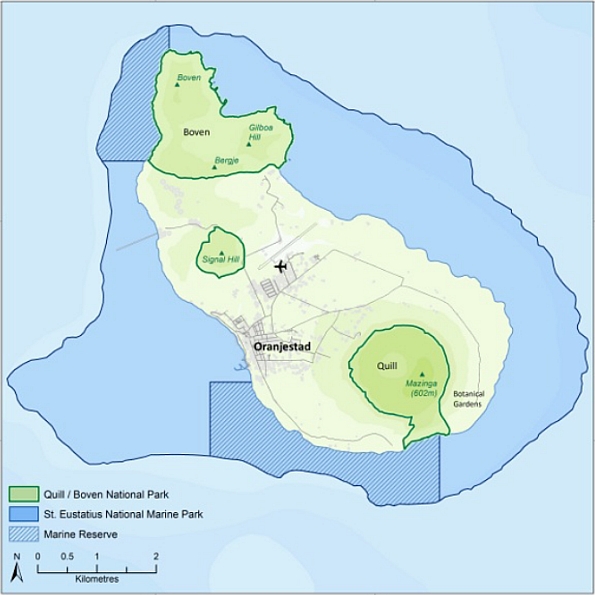
Jan. 9, 1996: The Sint Eustatius National Marine Park is created, surrounding the entire island from the high-water line to the 30-m depth contour.
March 21, 1997: The Quill/Boven National Park is established.
May 7, 1999: In Island Council elections, the SEA wins 49.5% of the vote (3 of 5 seats), the DP 41.4% (2), and the Sint Eustatius Action Movement (SAM) 9.1% (0).
May 23, 2003: In Island Council elections, the DP wins 42.5% of the vote (3 of 5 seats), the Progressive Labour Party (PLP) 31.4% (2), the SEA 14.4% (0), and the SAM 9.7% (0).
Oct. 8, 2004: A commission established by the Dutch and Antillean governments recommends the dissolution of the Netherlands Antilles. The commission proposes that Bonaire, Sint Eustatius, and Saba (the "BES Islands") should be directly administered by the Dutch government as koninkrijkseilanden ("kingdom islands").
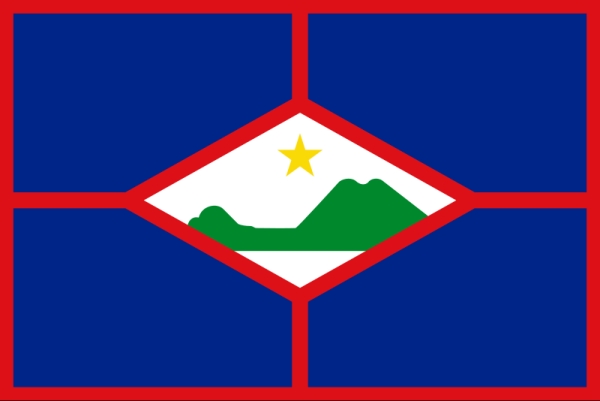
Nov. 16, 2004: A flag is adopted. Designed by Zuwena Suares, it consists of four five-sided blue areas (symbolizing the oceans that surround the island), each fimbriated red (symbolizing the flamboyant tree, used by the slaves to celebrate emancipation in 1863), and in the centre a diamond-form white field (alluding to "Once a Diamond Water-fall" in the anthem); in the diamond is the silhouette of the island in green and in the top of the diamond a five-pointed golden star (symbolizing unity). A coat of arms is also adopted, including the Latin motto "Superba et Confidens" ("Proud and Confident").
April 8, 2005: In a nonbinding referendum, 76.6% vote to remain in a restructured Netherlands Antilles, while 20.6% vote for direct ties with the Netherlands, 2.2% for integration with the Netherlands, and 0.6% for independence. Turnout is about 56%.
Nov. 26, 2005: A preliminary agreement with the Dutch government is signed in Curaçao that the extant federation be dissolved by July 1, 2007. The status of koninkrijkseiland, equivalent to that of a Dutch province, is subsequently refined to that of a bijzondere gemeente ("special municipality") or officially an openbaar lichaam ("public body" or "public entity"), similar in most ways to metropolitan Dutch municipalities, but not being part of a province, and with separate social security and currency arrangements.
Oct. 11, 2006: An agreement confirming Sint Eustatius's impending accession to special municipality status is signed in The Hague, Netherlands, and includes provisions for citizens to participate in Dutch national and local elections and in elections to the European Parliament.
March 2007: Sint Eustatius says that it will not permit same-sex weddings, even though such ceremonies are recognized in the Netherlands.
April 20, 2007: In Island Council elections, the DP wins 55.4% of the vote (4 of 5 seats), the PLP 23.8% (1), and the Statia Empowerment Party (STEP) 18.7% (0). Turnout is 75.7%. The elected members are Julian Woodley, Roy Hooker, Adelka Spanner, and Reginald Zaandam for the DP, and PLP leader Clyde van Putten.
Dec. 15, 2008: The Dutch prime minister, Jan Peter Balkenende, and the Antillean premier, Emily de Jongh-Elhage, sign an agreement for a phased dismantling of the federation to be completed by Jan. 1, 2010.
Sept. 30, 2009: It is decided that the federation will be dissolved on Oct. 10, 2010.
March 5, 2010: Gerald Berkel is appointed administrator as of April 1.
Oct. 10, 2010: Sint Eustatius, like Bonaire and Saba, becomes a special municipality of the Netherlands. The position of representative of the national government (rijksvertegenwoordiger, or kingdom representative) for the BES Islands (Caribisch Nederland) is instituted, based in Bonaire (see Bonaire for appointments etc.). With the post of governor of the Netherlands Antilles gone, the gezaghebber comes to be called in English island governor instead of lieutenant governor.
Jan. 1, 2011: The U.S. dollar is formally adopted as the island's currency; the Island Council opposed the introduction of the euro, the currency of the Netherlands (Sint Eustatius is not considered an integral part of the European Union but an overseas territory in association with it).
March 2, 2011: In elections to the Island Council, the DP wins 35.2% of the vote (2 of 5 seats), the United People's Coalition (UPC) 24.7% (1), the PLP 20.3% (1), the STEP 17.5% (1), and "List 4" (a non-party "blank list," headed by Wilhelm "Joshua" Spanner) 2.3% (0). Turnout is 68.0%.
February 2012: Koos Sneek and Glenn Schmidt become members of the government as Sneek's DP forms a coalition with the single-member group of Millicent Lijfrock-Marsdin who left the PLP to form her own Statia Liberal Action Movement (SLAM).
Sept. 12, 2012: The first opportunity for Statians to vote in Dutch polls comes with elections to the Second Chamber. The Labour Party wins 28.2% of the local vote, the Democrats 66 27.9%, the Socialist Party 21.8%, and the People's Party for Freedom and Democracy 8.8%. Turnout is 15.6%.
Dec. 13, 2012: Carlyle Tearr replaces Glenn Schmidt in the government after the latter lost the support of Lijfrock-Marsdin.
July 6, 2013: Reginald Zaandam replaces Sneek in the government, after the latter lost a no-confidence vote.
May 22, 2014: In elections to the European Parliament on Sint Eustatius, the Democrats 66 win 38.5% of the vote, ikkiesvooreerlijk.eu ("I vote for honesty") 15.4%, GreenLeft 11.5%, and the Labour Party 9.2%. Turnout is 7.4%.
Dec. 17, 2014: Another referendum on Sint Eustatius's constitutional relationship with the Netherlands is held. 65.5% vote in favour of the island becoming an autonomous territory within the kingdom, 32.8% for the status quo, 1.2% for integration with the Netherlands, and 0.4% for independence. However, the turnout, at 45.4%, is below the 60% threshold to be legally valid.
March 18, 2015: In elections to the Island Council, the PLP wins 30.4% of the vote (2 of 5 seats), the DP 29.9% (2), the UPC 15.4% (1), "List 6" (including former government member Glenn Schmidt) 11.5% (0), the STEP 8.5% (0), and the SLAM 4.2% (0). Turnout is 65.5%. The elected members are Rechelline Leerdam and Clyde van Putten (PLP), Adelka Spanner and Koos Sneek (DP), and Reginald Zaandam (UPC). Astrid McKenzie-Tatem (in charge of finance, economic and legal affairs, etc.) and Zaandam (constitutional affairs, housing and environment, etc.) are subsequently elected members of a PLP-UPC coalition government. Reuben Merkman (UPC) replaces Zaandam on the Island Council.
Aug. 31, 2015: The Island Council approves (3-1) a no-confidence motion against Administrator Gerald Berkel. Berkel rejects this as an act of protest directed at the Dutch government (relations between the island and the mainland deteriorated earlier in the year following a spending dispute).
Oct. 12, 2015: A committee, chaired by Liesbeth Spies, to evaluate the success of the new administrative arrangements in Bonaire, Saba, and Sint Eustatius since October 2010 presents its findings. The committee concludes that, in spite of positive results, as in health care and education, much is still disappointing: economic development has been limited, poverty has increased, and islanders feel that they have not been involved in the changes enough, and that insufficient account has often been taken of the special circumstances on the islands, the committee making specific note of the tense relations between Sint Eustatius and the mainland.
February 2016: Ronald Plasterk, the Dutch minister of the interior and kingdom relations, visits Sint Eustatius and signs a five-year socioeconomic development plan for the island.
April 1, 2016: Julian Woodley becomes acting administrator.
May 10, 2016: Zaandam resigns from the government, effective May 18. He is replaced by Derrick Simmons.
May 12, 2016: The Dutch government, in response to the evaluation committee report, announces proposals to counter poverty and to encourage investment, employment, and development in Bonaire, Saba, and Sint Eustatius. Island administrations will also be given more support. The main political parties dismiss the Dutch proposals as unfocused and limited in scope. On June 28 the First Chamber (the upper house of the Dutch parliament) approves a motion on the establishment of a minimum standard of living in the three islands. The Second Chamber (lower house) adopts a similar motion on October 25.
Aug. 18, 2016: Island Council member Reuben Merkman resigns from the UPC and declares himself an independent, while continuing to support the government. Derrick Simmons also resigns from the party but remains member of the government.
Nov. 30, 2016: Charles A. Woodley is sworn in as member of the government after a no-confidence motion is passed (3-0, the DP abstaining) against Astrid McKenzie-Tatem.
2017: The use by the Venezuelan oil company Petróleos de Venezuela (PDVSA) of one of its terminals is suspended after the company defaulted on a payment. The economy of Sint Eustatius is primarily based on oil transshipment, commerce and harbour activities, and the public sector. The most important private company is Statia Oil Terminal.
March 15, 2017: In the elections to the Dutch Second Chamber on Sint Eustatius, the Christian Democratic Appeal (CDA) wins 78.2% of the vote and the Democrats 66 6.3%. Turnout is 23.3%.
May 9, 2017: The Island Council adopts a motion that rejects the validity of various Dutch laws in force in the territory, if they are in conflict with the UN Charter and resolutions. The mainland government dismisses this as illegal. Simmons subsequently says that the Dutch government should "dutifully" comply with its UN obligations and "Failure to do so could trigger the provisions under Article 6 of the UN Charter, with all possible consequences for the position of the Netherlands' membership to the UN." On May 24 the Dutch minister of the interior and kingdom relations, Ronald Plasterk, requests a Committee of Wise Men to conduct an investigation and make recommendations.
September 2017: Hurricanes Irma and Maria cause substantial damage to infrastructure and housing stock on Sint Eustatius. The mainland authorities pledge to provide the island with some €47 million of reconstruction funding.
Oct. 31, 2017: The Dutch parliament approves a constitutional amendment that formalizes the status of Bonaire, Saba, and Sint Eustatius as public bodies; previously their constitutional basis was only secured in the Kingdom Charter, not the Dutch constitution. In addition, an Electoral College (Kiescollege) will ensure that residents with Dutch nationality can indirectly vote for the First Chamber. The influence is very limited, however, as the three islands together represent less than the amount of votes needed for one actual seat in the chamber. Sint Eustatius political leaders condemn the reform as an unlawful move that violates the island's right to self-determination.
2018: Real GDP, which grew by 6.6% in 2017, contracts by 11.8% this year owing to difficulties in the oil sector and the economic disruption caused by Hurricanes Irma and Maria.
Feb. 5, 2018: The Committee of Wise Men, consisting of Fredis Refunjol and Jan Franssen, presents its report. It accuses the authorities of "gross neglect of duties," financial mismanagement, and various acts of "lawlessness" - including unilateral and unconstitutional attempts forcibly to acquire greater autonomy - and recommends direct intervention by the Dutch government. Various measures were put in place previously to deal with the concerns but to limited effect, thus the need for a stronger response. The Dutch government accordingly announces its decision to impose direct rule. On February 6 the Dutch parliament adopts legislation to that effect, dissolving island institutions and removing from office the acting administrator, Julian Woodley. On February 7 Mike Franco, the former president of Curaçao's legislature, is appointed government commissioner to administer the territory. Elections to the Island Council, due to take place in March 2019, are postponed to allow time for fiscal, electoral, and governance reforms to be implemented. No date is given for the return of self-rule. A legal appeal against the Dutch intervention, filed by the deposed members of the Island Council, is rejected in December; another similar legal case is dismissed in October 2019.
Early May 2018: U.S. oil firm ConocoPhillips moves to seize control of PDVSA's oil assets in Sint Eustatius until the Venezuelan company agrees to pay $2,000 million in debt. On August 20 an agreement is announced between PDVSA and NuStar (the U.S. company that owns and operates Statia Oil Terminal) over outstanding storage fees.
June 29, 2018: The Dutch government announces measures to reduce poverty and improve employment in Bonaire, Saba, and Sint Eustatius. On July 13 the mainland authorities announce a €30 million poverty alleviation and economic development fund, the investments to be made contingent on good governance and sound financial management.
Feb. 26, 2019: NuStar terminates its commercial relationship with PDVSA. On July 30 Prostar Capital, a U.S.-based energy investment firm, completes its purchase of Statia Oil Terminal.
March 20, 2019: In the first elections to the Electoral College for the Dutch First Chamber, the DP is unopposed and takes all 5 seats. In the College's vote on May 27, the Sint Eustatius electors give all 5 votes to the CDA.
May 23, 2019: In elections to the European Parliament on Sint Eustatius, the CDA wins 53.5% of the vote, the Democrats 66 24.5%, and GreenLeft 6.5%. Turnout is 8.5%.
June 27, 2019: The Dutch government sets the "social minimum" for Sint Eustatius at $1,056 per month. To this end, the Netherlands announces further measures to increase local incomes, including a rise in the minimum wage.
July 2019: Former government member Neuman Norris Pompier (b. Aug. 17, 1952, Aruba) dies.
Nov. 29, 2019: The first public same-sex marriage in Sint Eustatius is held.
Jan. 24, 2020: The Dutch government appoints Marnix van Rij as government commissioner, effective February 15.
March 5, 2020: Prostar Capital announces its intention to invest up to $100 million in upgrading the oil terminal. On June 2 it is announced that Dutch energy firm Vitol has been contracted to manage bunkering operations at the terminal.
March 31, 2020: The first confirmed case of the new coronavirus disease (COVID-19) in Sint Eustatius is announced. The authorities declare a state of emergency, impose temporary restrictions on travel, order the closure of schools and non-essential businesses, and announce a ban on large gatherings. The apparent success of these policies in containing the spread of COVID-19 prompts the territorial administration to ease some restrictions from May, although the authorities continue to control the island's borders. Following a rise in cases in September, further restrictions are imposed; these are relaxed in October. Meanwhile the Dutch government in April announces emergency funding of €13 million to support businesses and workers in Sint Eustatius, Saba, and Bonaire. However, government representatives request more comprehensive measures to offset the economic effects of the pandemic. Air tourist arrivals decline from 10,500 in 2019 to just 3,300 in 2020 as a result of the COVID-19 crisis. The majority of visitors in 2020 travel from the Netherlands (including the Dutch Caribbean) and the U.S.
July 7, 2020: Dutch legislation is approved whereby the Netherlands' direct administrative control of the territory will be extended but gradually phased out.
2020-21: The Netherlands agrees to provide further emergency financial assistance to the special municipalities, and Dutch medical and humanitarian aid is also dispatched to the islands. In October 2020 the government introduces a COVID-19 relief package of $375,000 to assist entrepreneurs and stakeholders not already funded by the local or metropolitan governments.
Oct. 21, 2020: With progress being made on the territory's reform agenda, delayed Island Council elections are held. The PLP wins 51.4% of the vote (3 of 5 seats), the DP 40.8% (2), and the UPC 7.8% (0). Turnout is 76.9%. On October 30 Koos Sneek, who was elected as a DP member, announces his withdrawal from the party and declares himself independent, citing a difference of opinion with DP leader Adelka Spanner on the strategy to move forward after the election loss. The new Council initially only has limited powers and is unable to adopt new legislation or approve new spending. Additional powers would be delegated to the council members at a later stage, along with the appointment of a new administrator and the formation of a new government.
Feb. 22, 2021: With support from the Netherlands, vaccinations against COVID-19 begin; by September 1 some 72% of the population has received at least one dose of a vaccine. The government commences a phased reopening of the territory in April. At September 1, according to the World Health Organization, there have been 24 confirmed cases of the virus on the island.
March 17, 2021: In the elections to the Dutch Second Chamber on Sint Eustatius, the Ubuntu Connected Front wins 50.8% of the vote, the CDA 32.5%, and Democrats 66 4.8%. Turnout is 33.8%.
April 3, 2021: Government Commissioner Marnix van Rij announces his resignation, effective April 18. His deputy Alida Francis then becomes acting government commissioner.
June 18, 2021: Alida Francis is appointed government commissioner, effective June 22.
Aug. 27, 2021: A new airport terminal opens, about 4 times the area of the former building.
October 2021: The European Union approves a new association agreement, which provides for EU development funding for Sint Eustatius and the other Dutch Caribbean territories during 2021-27.
Jan. 19, 2022: Sint Eustatius registers the first COVID-19 death. According to the World Health Organization, by September 5 there have been 1,194 confirmed cases, including five deaths.
March-May 2022: A mediation process, led by former Netherlands Antilles prime ministers Maria Liberia-Peters and Susanne Camelia-Römer, is conducted in an effort to resolve ongoing disputes between the Island Council and Government Commissioner Francis over policy and the timeline for the restoration of the island administration's powers. The mediation process yields a new cooperation agreement (signed June 14) to support the socioeconomic development of the island during 2022-23, as well as a Multi-year Implementation Plan for 2022-26.
May 2022: In response to high rates of poverty in Sint Eustatius, the Dutch government increases various social benefits on the island and announces the introduction of an unemployment benefit. Additional financial resources are also to be allocated to the territory.
May 23, 2022: Former government member Nora Sneek (wife of Island Council member Koos Sneek) dies.
Oct. 3, 2022: The Island Council regains the power to appoint government members. The PLP's Glenn Schmidt and Derrick Simmons are appointed.
March 15, 2023: In elections to the Island Council, the PLP wins 55.7% of the vote (3 of 5 seats), the DP 37.7% (2), and the CDA 6.7% (0). Turnout is 80.6%. The elected members are Rechelline Leerdam, Reuben Merkman, and Clyde van Putten for the PLP and newcomers Rachel Spanner-Carty and Mercedes Lopes-Spanner for the DP. In the elections to the Electoral College, the DP receives 71.1% of the vote (4 seats) and the CDA 28.9% (1). In the College's vote on May 30, the Sint Eustatius electors give 4 votes to the Democrats 66 and 1 to the CDA. Meanwhile in April a government is formed consisting of Reuben Merkman and Arlene Spanner-Schmidt. Merkman is replaced on the Island Council by Glenn Schmidt.
June 20, 2023: The government regains full authority to draft and implement its own budget.
Nov. 11, 2023: Former member of the Island Council and government Eric Elvin Henriquez (b. Nov. 25, 1933) dies.
Nov. 22, 2023: In the elections to the Dutch Second Chamber on Sint Eustatius, the Democrats 66 win 51.7% of the vote, the Farmer-Citizen Movement 23.4%, New Social Contract 7.0%, and GreenLeft/Labour Party 4.6%. Turnout is 17.7%.
The government in July 2024 (left to right): Reuben Merkman, Alida Francis (administrator), and Rechelline Leerdam. |
Jan. 1, 2024: Population: 3,204.
April 10, 2024: Alida Francis, hitherto the government commissioner, is sworn in to the restored position of administrator, essentially ending the administrative intervention, although the acting kingdom representative has a number of additional powers until September 1. Sharon Hassell is also sworn in as acting (i.e., deputy) administrator (waarnemend gezaghebber).
June 6, 2024: In elections to the European Parliament, local turnout is 9.9%. The Democrats 66 win 56.9% of the vote, followed by GreenLeft/Labour Party with 22.3%.
July 15, 2024: Rechelline Leerdam is sworn in as member of the government, after Arlene Spanner-Schmidt was sent home by her party (PLP). Leerdam is succeeded on the Island Council by Derrick Simmons.
January 2025: The Regional Deal, a collaborative effort between the Sint Eustatius government and the government of the Netherlands, involving a range of initiatives aimed at sustainable development, cultural preservation (including the restoration of Fort Oranje), and improved social and economic resilience, backed by €10 million in funding, is launched.
Aug. 29, 2025: The Dutch government approves a bill to increase the number of members of BES Island Councils and governments, in Sint Eustatius's case from 5 to 7 and from 2 to 3 respectively, to take account of population growth. The expansion takes effect with the next elections in 2027.
Oct. 29, 2025: In the elections to the Dutch Second Chamber on Sint Eustatius, the New Social Contract wins 31.6% of the vote, the Democrats 66 21.8%, GreenLeft/Labour Party 14.6%, and the CDA 6.3%. Turnout is 10.7%.