Rulers: Tokelau: History
Tokelau
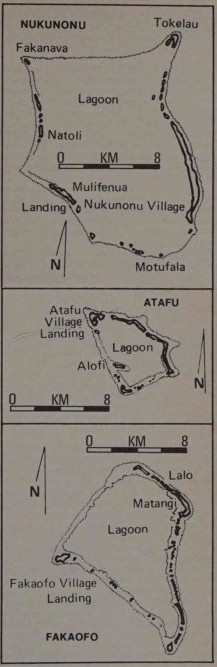
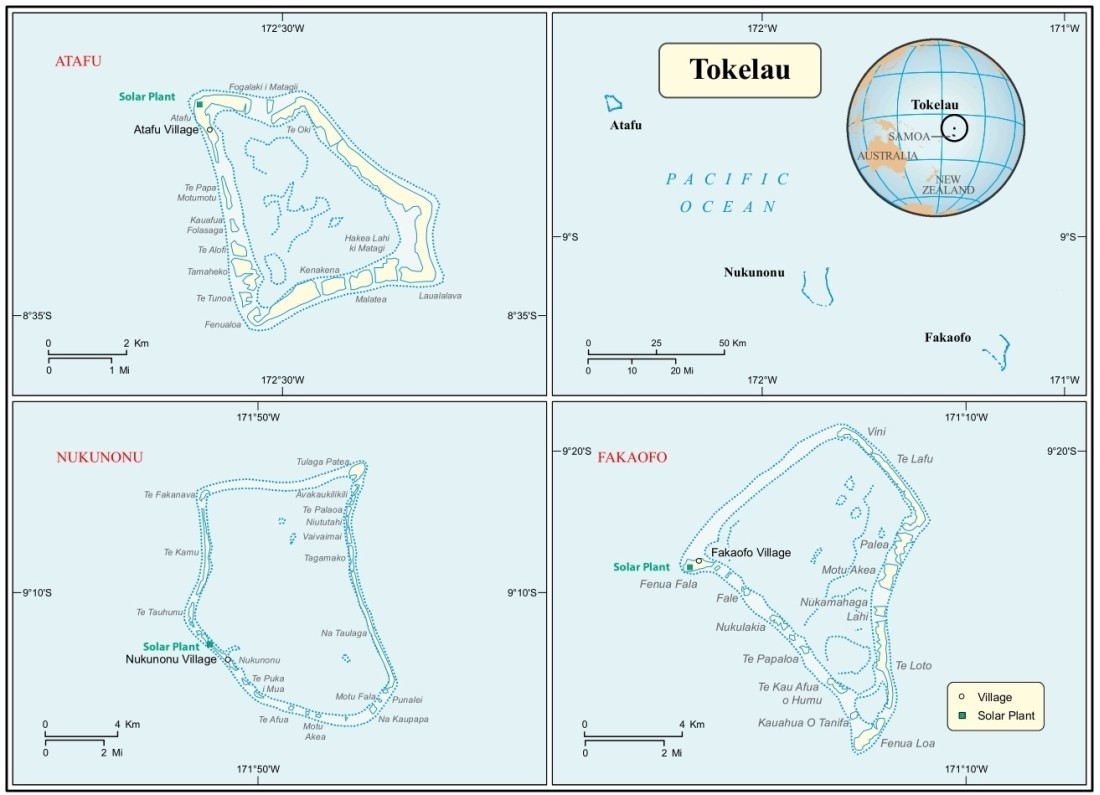
Tokelau, lying in the Pacific halfway between Hawaii and New Zealand, consists of three widely separated coral atolls consisting of 127 islets (motu) totalling 12 sq km. As indicated by linguistic affinity, Tokelau was probably settled (about 1000 CE) from Samoa, its nearest neighbour, by drift voyages, and the small atolls rapidly became densely settled with nucleated villages. (The name Tokelau means "north" or "north wind" and Tokelau lies north of Samoa.) Tokelauans have alternatively attributed their origin to Rarotonga (Cook Islands) or Nanumanga (in modern Tuvalu), besides stories of supernatural creation locally. Fakaofo formerly held supremacy over the other atolls, Nukunonu and Atafu, but Nukunonu, as the largest and central atoll, has more recently been considered the main island. The territory, however, does not have an official capital.
18th century or before: Fakaofo conquers Atafu (whose original population is put to flight) and Nukunonu, bringing them under the rule of the god Tui Tokelau, who is personified in a slab of coral at Fakaofo, carefully wrapped up in fine mats, and never seen by anyone but the ruler (Aliki), and even by him only once a year when the decayed mats are removed. Atafu and Nukunonu retain their own Aliki, but the one of Fakaofo is seen as paramount.
June 21, 1765: The first European visitor is the British commodore John Byron of the Dolphin, who gives Atafu the name Duke of York Island. He sends two boat parties ashore, but they find no sign of inhabitants.
June 6, 1791: Captain Edward Edwards of HMS Pandora stops at Atafu while he is searching for HMS Bounty mutineers. The crew which goes ashore finds no inhabitants but houses containing fishing gear and canoes, suggesting that the island is used as a temporary residence for fishing parties. Six days later Edwards sights Nukunonu and names it Duke of Clarence Island.
Late 1820s: Whalers begin visiting the group and are the first to see people on Atafu. Presumably the island has been resettled sometime since 1791. Tradition has it that Tonuia, from Fakaofo, was commissioned to colonize Atafu which he did with his wife Lagimaina, from Nukunonu.
Feb. 14, 1835: Captain Smith of the U.S. whaler General Jackson makes the first definite Western sighting of Fakaofo, naming it D'Wolf's Island after the ship's owner. It appears, though, that Lt. Hiram Paulding of USS Dolphin, who in 1825 (when only two atolls were believed to exist in the area) reported encounters at sea at Nukunonu (where the people were hostile) and on land at Atafu (where they were timid), misidentified these and was actually at Fakaofo and Nukunonu, respectively.
January 1837: The British whaler Admiral Cockburn sends a party ashore for wood at an island claimed to be Nukunonu, but probably Fakaofo. The party is threatened into retreat, and when later a "large fleet of canoes" approaches the ship, the British fire on them, sink some of the canoes, and the islanders retreat. This incident may explain the apparent subsequent moderation of the Fakaofo men: in 1839 the captain of the General Jackson reports that he "found the natives friendly."
January 1841: A thorough survey is made by the United States Exploring Expedition; its ethnologist, Horatio Hale, gives a detailed report on local customs and language, and the expedition (unaware of the earlier discovery) gives Fakaofo the name Bowditch Island (after U.S. mathematician and astronomer Nathaniel Bowditch), which remains in use for many years, and calls all three islands the "Union Group." Fakaofo's population is estimated at 500-600 and Atafu's at 120. No observations are made at Nukunonu, where the expedition is unable to land owing to contrary weather.
1844: 12 crew members of the French whaler Angeline are killed at Atafu after having "given offense by unwelcome familiarity with the women," as one account puts it.
1846: A hurricane devastates Fakaofo, uprooting all the coconut trees and forcing the people to temporarily leave the island to avoid starvation.
July 6, 1851: The British bark Novelty is wrecked on Nukunonu. The captain and three of the crew reach 'Upolu, Samoa, on July 30, after three days in a longboat.
February 1852: The French bishop Pierre Bataillon, vicar apostolic of Central Oceania, working with a French beachcomber known as Hula, sends a ship under the leadership of Father Louis Padel which transports almost 500 reluctant Tokelauans from Fakaofo to `Uvea (Wallis) ostensibly to save them from a famine. Before leaving, Hula sets fire to the god-house of Tui Tokelau. Reportedly only 90 are left behind. However, an anonymous visitor to Fakaofo in 1853 reports a population of 250, half the estimated total Tokelau population of 500. If these numbers are correct, some of the transported people must have returned, or people must have come from other islands.
1858: A Fakaofoan named Faivalua, who was converted to Christianity by the London Missionary Society in Samoa, tries to convert his home island, but when his message is not welcome, goes on to Atafu where, by 1861, he is successful.
1859: Captain William W. Taylor, a whaler from Massachusetts, claims the islands, including Olohega (Swains Island), under the U.S. Guano Act.
1861: Takua from Nukunonu, who became a Catholic convert in `Uvea in 1852, returns and successfully converts the island.
December 1862: A missionary party from Atafu arrives in Fakaofo but is rebuffed by Aliki Lika. A proclamation is made that "all who wished to follow Jehovah must leave Fakaofo." 46 Fakaofo people join the Atafu group on departing. They subsequently lose their bearings at sea but ultimately arrive at Samoa. Less than a week later, they make their way again to Fakaofo. Dysentery breaks out on the ship, but the people are nonetheless landed, with the result that dysentery kills 64 people in three weeks. Nevertheless, after the castaways tell the story of their adventures and the missionaries attribute their good fortune to the goodness of God and the Protestant mission, the Aliki relents and allows the new religion, though not embracing it himself.
February 1863: Peruvian slave raiders abduct about 250 islanders (by the ploy of telling them to go into the ship's hold for trading and then trapping them there, but also on land by violent means), and the ships that take captives from Fakaofo also take aboard virulent dysentery introduced by the mission ship. The population is reduced to about 200. Beachcombers of diverse Western nationalities and some Polynesian immigrants subsequently settle and intermarry with Tokelauans.
1863: After Benjamin Hughes (called Peni, a U.S. trader), who may have been abetted by Protestants, forced Lika to sign a document of sale granting him title to the islet of Fenuafala, Lika is persuaded to convert to Catholicism. Catholics gain a presence on Fakaofo, which remains denominationally mixed (though with Protestants predominating), in contrast to the almost exclusively Protestant Atafu and Catholic Nukunonu.
1866: Locally harassed, Peni sells his interest in Fenuafala to the German firm Godeffroy & Sohn and disappears. One of the Portuguese settlers, a Cape Verde Islander of African descent, Antonio Pereira (called Atone), then obtains the lease of the islet from the German firm for $100 a year and comes to dominate the local copra-based commerce.
July 26, 1867: The German ship Ophelia runs upon Atafu's eastern reef. The community generously provides for the captain and crew for eight or nine months. A two-masted vessel is fashioned from the wreckage of the ship and two Atafu men escort the shipwrecked party on their voyage to Samoa.
1870: Atone leaves Fakaofo, leaving his business to his son José Pereira, known as Peleila.
1874: Atone, while living in Samoa, fraudulently "buys" the islets of Fenualoa and Nukumatau from two Fakaofo men, creating much disturbance. Atone and Peleila consolidate their occupation of the islets by bluff and threat of arms. In late 1880 the British consul in Apia writes to the people of the island requesting them not to "further interfere with Peleila, who is under British protection."
Aug. 13, 1877: British interest begins with the Western Pacific Order-in-Council when the high commissioner for the Western Pacific in Fiji receives jurisdiction over British nationals in Tokelau.
May 7, 1881: In a fight between the two religious groups on Fakaofo that began in 1880, the Aliki, Vaopuka (a Protestant), is shot; he dies from his wound the following month. He is succeeded by Te Taulu, Lika's elder son, who is a Protestant.
June 20-22, 1889: HMS Egeria visits, raises the Union Jack on each island, and declares the islands, as Union Group, a British protectorate, under the high commissioner for the Western Pacific. In the following two decades, three deputy commissioners (T.B. Cusack Smith, Ernest Maxse, Hamilton Hunter), authorized from Fiji, pay seven brief visits to the islands from their posts in Samoa (to 1900) and Tonga (from 1901).
1902: The German firm (now Deutsche Handels- und Plantagen-Gesellschaft) sells Fenuafala to Peleila for £400. The issue is defused as his family becomes integrated into village life, one of his sons becoming a popular faipule, and likewise his son after him.
1909: Tokelau is made subject to the laws of the Gilbert and Ellice Islands protectorate (modern Kiribati and Tuvalu). After a 4½-month journey, a district magistrate, Roderick MacDermot, reaches Nukunonu in March 1910. He is succeeded by F.J. Hoare (May 1913-April 1914) and Lancelot Indermaur (April-December 1914); the period of "direct rule" then ends and Tokelau is included within the jurisdiction of the district officer at Funafuti.
1914: A dysentery epidemic carries off 34 persons on Atafu.
Jan. 7, 1914: A great cyclone hits all atolls. Nukunonu suffers the greatest losses, seven people being swept away, though three return the following day, having clung to flotsam as they were propelled right across the lagoon. At Atafu the church and most of the houses are demolished and many coconut palms are levelled to the ground.
Feb. 29, 1916: By order-in-council (published in the Western Pacific High Commission Gazette on May 5), the Union Group becomes part of the Gilbert and Ellice Islands colony, the chiefs having signed deeds of cession on January 25 and 26. The position of Aliki disappears with annexation. Colonial administration is carried out by the district officer at Funafuti who is responsible to the resident commissioner of the Gilbert and Ellice Islands based in Tarawa. Each island has a faipule responsible for general government administration. To assist with those duties there is a native magistrate (fakamahino) who also supervises law enforcement. A number of Tokelauans subsequently are recruited to work the phosphate deposits of Banaba (Ocean Island).
Feb. 22, 1918: The resident commissioner of the Gilbert and Ellice Islands consults with 20 Nukunonu elders about "removing the rule of Fakaofo," and it is agreed that Nukunonu will pay 4 tons of copra in compensation and Fakaofo will abandon any claims to lands in Nukunonu. Nukunonu had effectively ruled itself for over half a century, but now this autonomy is officially recognized.
1920s: On each atoll a Women's Committee is established, its main role being to promote hygiene in the villages.
November 1925: Tokelau is detached again from the Gilbert and Ellice Islands, and the governor-general of New Zealand becomes governor of Tokelau, effective Feb. 11, 1926. The authority of the governor-general of New Zealand is delegated to the administrator of Western Samoa (modern Samoa).
1931: The first inter-atoll kilikiti (cricket) "test" is played between Fakaofo and Atafu.
1936: An aumaga (workforce) along Samoan lines is established on Fakaofo, and in 1939 on Atafu.
1936: Population: 1,170 (Atafu 378; Fakaofo 508; Nukunonu 284).
May 1944: The U.S. Coast Guard arrives on Atafu to set up a Loran (Long Range Navigation) station during World War II. The station is operational from Nov. 15, 1944, to May 15, 1946.
Dec. 24-25, 1944: The first visit by a New Zealand prime minister to the islands is made by Peter Fraser, landing by plane in Atafu during a South Pacific tour.
September 1945: Census population: 1,388 (Atafu 451; Fakaofo 570; Nukunonu 367).
May 7, 1946: The Union Group is renamed Tokelau Islands by the Tokelau Nomenclature Ordinance 1946. The spelling of Fakaofo (previously also Fakaofu) is fixed.
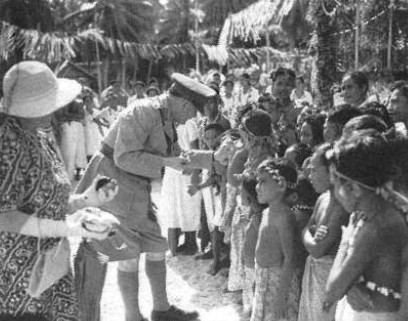
New Zealand governor-general Sir Bernard Freyberg on a tour of the Tokelau Islands, in Nukunonu, July 1948. |
Oct. 29, 1948: The Tokelau Islands Act (effective Jan. 1, 1949) makes the group part of New Zealand, which appoints the islands' administrator; the position is given to the high commissioner of Western Samoa (as the administrator of Western Samoa has become). Until 1962 cultural and language ties to Samoans lead some Tokelauans to migrate to Western Samoa; Tokelau's population still grows.
Sept. 25, 1951: Census population: 1,571 (Atafu 458; Fakaofo 662; Nukunonu 451).
1955: A Tokelau district officer, based in Western Samoa, begins to be appointed to manage the administration of Tokelau. The position is first held by Roger Pearless, who is among 25 people on board the Joyita departing Samoa for Fakaofo on Oct. 3, 1955, never to be seen again - five weeks later the vessel is found adrift near Fiji with no one on board. Subsequent district officers are Lloyd Webber, Godfrey Garnett, and finally (1971-75) Don Stewart.
Sept. 25, 1956: Census population: 1,619 (Atafu 488; Fakaofo 666; Nukunonu 465).
1958: Landing conditions at the main settlements of all three atolls are greatly improved by reef blasting, using obsolete ammunition delivered by Royal New Zealand Navy craft.
1958: A World Health Organization mosquito eradication experimental project, employing a fungus at Nukunonu and an insecticide at Atafu, is commenced.
October 1958: The only total eclipse of the Sun to occur during the International Geophysical Year is observed by a joint U.K.-New Zealand astronomical team at Atafu.
1960: On Fakaofo, a second village is established on the island of Fenuafala, to relieve the overcrowding.
Sept. 25, 1961: Census population: 1,870 (Atafu 574; Fakaofo 783; Nukunonu 513).
1962: Tokelau is listed in the schedule of territories under the supervision of the UN Special Committee on Decolonization ("Committee of 24").
Jan. 1, 1962: With the independence of Western Samoa, the New Zealand high commissioner there (now equivalent to ambassador) remains the administrator of the Tokelau Islands.
1963: Migration shifts to New Zealand, which starts a scheme to bring Tokelauan women to New Zealand to work as domestics.
1963: Increasing calls for a combined meeting of the villages to discuss matters relating to Tokelau as a whole results in a national policy and planning meeting of representatives from each island, a forerunner to the General Fono.
Oct. 2, 1963: The Tokelau Islands Amendment Act 1963 vests a portion of the islet of Fenuafala (part of Fakaofo atoll) in the native inhabitants of Fakaofo "to be held by them and their descendants according to their native customs and usages."
December 1964: The first General Fono (Fono Fakamua) convenes, following the return to Tokelau of a group which visited other islands in the region, and a resolution is adopted stating that Tokelauans do not wish to join either Western Samoa or the Cook Islands and that they prefer to continue to be associated directly with New Zealand.
1965-66: Filariasis, which until recently was common in the Tokelaus, is almost completely eradicated by a campaign sponsored by the New Zealand Medical Research Council.
1965: Units of the New Zealand army engineers stay three months on Fakaofo and deepen the reef channel there.
November 1965: The Western Samoa Trust Estates cease to carry out trading operations in the Tokelaus. This activity is subsequently taken over by the Apia firm of Burns Philp (South Seas) Company Ltd.
January 1966: Cyclone Connie lashes the islands. The reef channel at Fakaofo is partly filled with debris. The storm badly affects Nukunonu, destroying the meeting house and damaging breadfruit trees. Aided by a just-presented Resettlement Scheme (as the 1963 scheme is now formalized), a significant number of people subsequently leave for New Zealand, leading to a rapid decline of the atoll's population which had been rising since 1951.
Sept. 24, 1966: Census population: 1,901 (Atafu 615; Fakaofo 733; Nukunonu 553).
1967: The Tokelau Islands Amendment Act 1967 (which comes into force Jan. 1, 1969) establishes a Tokelau Public Service, with headquarters in Apia, Western Samoa. The act also provides that islanders may dispose of land by custom among themselves, but may not alienate land to non-indigenes other than to the crown. Land holdings pass from generation to generation within families, being held by the head of a closely related family group, although some land is held in common.
April 1967: Sunderland flying-boats of the Royal New Zealand Air Force, which provided an important means of communication with the outside world, are withdrawn from service. They are subsequently replaced by chartered amphibian planes from Fiji.
1969: Three new schools are built and three New Zealand teaching couples take up positions at each of the three atolls to assist in raising the educational standard.
1969: The Tokelau Islands Amendment Act 1969 fixes the official spelling of Nukunonu, which previously was often spelled Nukunono (including in the 1948 act).
1970: The Tokelau Islands Amendment Act 1970 (coming into force Dec. 1, 1975) gives the High Court of Niue civil and criminal jurisdiction in Tokelau as if that court was established as a separate court of justice in Tokelau. The bill also establishes the office of commissioner for each atoll with judicial authority; the role may be filled by the faipule, who is exempt from the age limit of 68 and who may also exercise the functions during any incapacity or absence of the commissioner or vacancy in the post. The courts of Niue, a self-governing state from 1974, do not actually become courts for Tokelau as the necessary request and consent procedure of the Niue constitution is not followed.
1971: The Shaw Savill liner Ocean Monarch becomes the first passenger liner to visit the islands.
1971: A scientist of the New Zealand Department of Scientific and Industrial Research completes a rat-control scheme in the Tokelaus. It is hoped that this will lead to the eventual eradication of rats.
Jan. 1, 1972: The administrator begins to be based in Wellington, as the position is transferred from the high commissioner in Western Samoa to the secretary for Maori and island affairs.
1973-80: More than 100 young people are sent to school in New Zealand by the Scholarship Scheme.
Sept. 26, 1973: Census population: 1,587 (Atafu 572; Fakaofo 649; Nukunonu 366).
May 1974: The islands are without a regular shipping service after the withdrawal of the Pacific Navigation Company's Aoniu from charter. The administration then finds it difficult to find suitable ships until February 1975 when the Nauru Pacific Line ship Cenpac Rounder is chartered for regular calls.
November 1974: The administration of Tokelau is transferred from the Maori and Island Affairs Department to the Ministry of Foreign Affairs, effective in early 1975 when the New Zealand secretary of foreign affairs becomes ex officio administrator of the Tokelau Islands.
January 1975: The three faipule (village leaders) and three pulenuku ("mayors") are elected for three-year terms. Subsequently a by-election is held at Nukunonu following the sudden death of the recently elected pulenuku.
June 1975: A general discussion at the General Fono leads to the suspension of the Resettlement Scheme after assisting 528 people.
1976: The post of official secretary is established, replacing the district officer. It is held by Neil Walter (1976-78), Simon Carlaw (1978-79), John Larkindale (1981-82), Tony Browne (1983-85), Adrian Macey (1985-87), Casimilo J. Perez (1988-92), and Bryan Lawrence (1993-94).
1976: Three new hospitals are completed.
1976: The last New Zealand education officer departs. Thereafter, education advisers are recruited from New Zealand on two-year contracts. The first one is Eddie McKersey who completes his term in 1980, being succeeded by Brian Healey in 1981 and Barry Clarkson in 1983.
June 1976: The first UN mission to the islands finds that a small population (1,600, declining through migration), economic dependence, and remoteness cause the Tokelauans to oppose any plans for self-government or independence.
August 1976: Trading operations in the territory cease to be carried out by Burns Philp (South Seas) Co. Ltd. From August to December the operation is handled by the Office for Tokelau Affairs in preparation for the establishment of a village cooperative store on each island.
Oct. 25, 1976: Census population: 1,575 (Atafu 546; Fakaofo 666; Nukunonu 363).
Dec. 9, 1976: By the Tokelau Amendment Act 1976, the group is officially named Tokelau (omitting the word "Islands").
1977: A bad drought devastates the copra crop.
February 1977: A savings bank is established on each atoll.
Dec. 23, 1977: The Tokelau (Territorial Sea and Exclusive Economic Zone) Act 1977 is assented to, establishing an exclusive economic zone for Tokelau in accordance with the United Nations Convention on the Law of the Sea. It replaces the Tokelau (Territorial Sea and Fishing Zone) Act 1976 (assented to Dec. 10, 1976).
1978: Tokelau releases its first coin, a commemorative tala (dollar). The obverse shows the effigy of Queen Elizabeth II from a drawing by Arnold Machin of London. The reverse design is by Tokelauan artist Faraimo Paulo, of Atafu. His design shows the pandanus fruit, an important food for the islanders. Paulo was the first Tokelauan artist to study in New Zealand. (While the New Zealand dollar is legal tender, for convenience Western Samoan currency - likewise called tala - is used in the islands.)
March 1979: The Cenpac Rounder goes aground. Thereafter, charters are organized on an ad hoc basis.
Oct. 25, 1979: Census population: 1,615 (Atafu 577; Fakaofo 664; Nukunonu 374).
September 1980: The Tokelau administration regulations are amended so that the minister of foreign affairs is empowered to appoint a suitable person to be the administrator of Tokelau. Frank Henry Corner, who retired from his position as secretary of foreign affairs, is appointed to continue as administrator.
Dec. 2, 1980: For the first time, an international treaty is signed in the territory. The Treaty of Tokehega (combining the names Tokelau and Olohega) with the United States (entering into force with the exchange of ratifications Sept. 3, 1983) delimits the maritime boundary between Tokelau and American Samoa, and effectively disposes of the conflicting historical territorial claims, i.e. the U.S. claim to Tokelau, dating from 1859, and New Zealand's claim, on behalf of Tokelau, to Olohega or Swains Island (annexed to American Samoa in 1925).
June-July 1981: A second UN mission visits Tokelau. It again reports that the people do not wish to change the nature of the existing relationship with New Zealand.
Mid-1981: The MV Frysna belonging to Warner Pacific Line of Tonga begins a four-year charter arrangement.
Nov. 2, 1981: Census population: 1,572 (Atafu 554; Fakaofo 650; Nukunonu 368).
Late 1981: An air-link becomes operational using an amphibian aircraft chartered from Tuvalu.
1982: The Tokelau Amendment Act 1982 formally recognizes the General Fono which at this time consists of 45 members with equal representation from each island.
1982: The General Fono begins to levy a tax (called the Community Services Levy) on the salaries of public servants who are unavailable for the community service labour levy.
1983: The Letters Patent Constituting the Office of Governor-General of New Zealand 1983 spell out that the Realm of New Zealand has five parts: New Zealand; the self-governing states of the Cook Islands and Niue; Tokelau; and the Ross Dependency.
August 1983: The United Nations Development Programme (UNDP) sanctions a U.S.$695,000 telecommunications project linking the three atolls with each other and, through Western Samoa, with the outside world.
September 1983: The aircraft agreement expires. A few weeks earlier, Tuvalu decided to close down its domestic airline operations because it could no longer bear the cost.
October 1983: Tokelau becomes a member of the South Pacific Commission (from 1998 Pacific Community).
1984: A Health Committee is formed by the General Fono. Its goals and objectives call for an increased emphasis on prevention of diseases, health promotion, and community health programmes.
July 1984: The General Fono resolves to accept law in the Western sense as a necessary and desirable tool for assisting Tokelau to prepare for self-determination under the aegis of the UN. The elders resolve to develop local law in a way that is adapted to the needs of, and reflecting as far as possible the custom, of Tokelau.
March 1985: At the General Fono it is decided to ask the New Zealand government to invite another mission from the Committee of 24 to visit Tokelau in 1986 to observe the changing situation and to hear the views of Tokelauans on their political status. This duly takes place in July 1986, again showing no desire for a change of the status quo. Meanwhile, on Dec. 2, 1985, the UN General Assembly adopted a consensus statement on Tokelau, reaffirming the "inalienable right" of its people to self-determination and independence, noting that "for the time being" there existed no local desire to review the relationship with New Zealand, and welcoming "the assurances of the administering power that it will continue to be guided solely by the wishes of the people of Tokelau."
Jan. 21-25, 1985: New Zealand prime minister David Lange visits Tokelau. He announces the resignation of Administrator Corner owing to ill health. The new administrator, Harold Huyton Francis, deputy secretary of foreign affairs, takes office February 1.
January 1986: Interports Shipping of Suva, Fiji, begins to provide a monthly shipping service to Tokelau
with the MV Wairua under a contract with the New Zealand government.
July 1, 1986: The Tokelau Amendment Act 1986 comes into force, establishing the High Court of New Zealand as the High Court of Tokelau with appeals to the Court of Appeal of New Zealand as the Court of Appeal of Tokelau.
Oct. 10, 1986: Census population: 1,690 (Atafu 603; Fakaofo 661; Nukunonu 426); there are also (March 1986 census) 2,316 Tokelauans resident in New Zealand (up from about 600 in 1965).
Dec. 1, 1986: The Village Incorporation Regulations 1986 come into force, acknowledging the law-making power of the Taupulega (Council of Elders) for each village.
1987: The Committee of 24 reviews the status of Tokelau and accepts the realism of the island's current relationship with New Zealand, under which self-government is limited to local affairs and exercised through elected island councils. An emissary of the General Fono, the territory's highest advisory body, reiterated the Tokelauan position in June, expressing a desire to achieve a greater degree of political autonomy, while maintaining its relationship with New Zealand.
January 1987: Tokelau is devastated by Hurricane Tusi, which destroys nearly one-third of all housing.
1988: The first Tokelauan, Casimilo J. Perez, becomes official secretary.
October 1988: The General Fono agrees on a proposal for Tokelau to adopt its own flag and anthem. The Fono also supports a visit by the faipule and pulenuku to New Zealand for consultations with the administrator and the foreign minister, which take place the following month. The Tokelau delegation requests a delay in the construction of airstrips on each atoll, and a redirection of resources toward improving shipping services and widening the reef passages. The airstrip program, intended to reduce Tokelau's isolation, and authorized by the General Fono in April 1987, is postponed indefinitely. However, New Zealand undertakes to begin construction if and when Tokelau considers it is ready to introduce air service in the atolls, with costs met by allocations over and above New Zealand's annual budgetary grant.
1989: A Tokelau identity card is introduced for travel to Western Samoa.
1989: Tokelau supports efforts by the South Pacific Forum to impose a regional ban on drift-net fishing (which is believed to have resulted in a serious depletion in tuna stocks).
October 1989: A UN report on climate change lists Tokelau as one of the island groups likely to be completely submerged during the 21st century, owing to a rise in sea level, unless drastic action is taken.
November 1989: In response to local concern, New Zealand outlaws drift-net fishing within Tokelau's exclusive economic zone (extending to 200 nautical miles from the islands' coastline).
January 1990: Elections for the three faipule and three pulenuku positions are held. On Fakaofo (whose island council gives somewhat greater authority to the elders) both the faipule (Peniuto Semisi) and the pulenuku (Lui Kelekolio) are reelected, but new representatives are elected on the other two atolls. Atafu reelects its faipule (Kuresa Nasau) but chooses a new pulenuku, Paulo Kitiona, very popular with the aumaga (village workforce) and a young graduate of the University of the South Pacific. On Nukunonu, two new leaders, Salesio Lui (faipule) and Mika Koloi (pulenuku), are selected. The choice of Lui, 39, a graduate in political science from the University of the South Pacific and a schoolteacher, as faipule represents a particularly notable departure for a community that has always lodged authority and decision-making power with elders and older heads of families.
February 1990: Cyclone Ofa causes unprecedented damage to Tokelau. It destroys all banana trees and 80% of coconut and breadfruit trees, and wrecks two hospitals, schools, housing, and bridges; 22 houses are completely destroyed and a further 91 severely damaged. Vital seawalls, protecting the fragile Tokelauan land base from erosion, are washed away. The Apia-based Office for Tokelau Affairs issues a preliminary assessment of the costs for recovery at NZ$3.95 million. But this figure does not include all forms of damage, and other estimates range much higher; for example, the damage to the physical character of Nukunonu alone is assessed at NZ$22 million. A week after the storm, the Royal New Zealand Air Force delivers urgently needed supplies via airdrop, and further assistance arrives later by sea. While acknowledging New Zealand's support, each island's Taupulega is adamant about the need for more substantial measures. Tokelauans in New Zealand are requested to return to assist with recovery operations.
April 26-27, 1990: A Tokelauan member of New Zealand's Ministry of External Relations and Trade, Falani Aukuso, reports to the UN Committee on Decolonization "on behalf of the faipule and the people of Tokelau." This is only the second time that the committee has been addressed by a "special representative" of Tokelau. Aukuso's statement indicates that Tokelau's "partnership" with New Zealand "feels right and we wish [it] to continue." He also seizes the opportunity to speak out on international issues, including climate change: "We are a tiny dot... Nevertheless we do exist, and we do have a voice... If we are to believe our knowledgeable scientists our 'voice' will disappear forever in 50 years' time. We have no one else to turn to but the government of New Zealand and the United Nations." In May, Official Secretary Casimilo Perez tells a UN-sponsored seminar in Vanuatu that his country possesses special characteristics; that the people of Tokelau believe that if they entered into a new relationship with New Zealand, there would be no turning back; and that any new relationship would have to conform to the traditional practices of the leadership of Tokelau. In August the committee adopts a resolution recording the wishes of the people of Tokelau to maintain their current relationship with New Zealand.
July 1990: Graham Ansell is appointed administrator. His appointment was made by the New Zealand foreign minister in consultation with the three faipule.
September 1990: Operation Gabion (named after an Australian-manufactured basket used to stabilize sea walls) is launched, dispatching three 15-man teams from the army's Engineer Squadron, one to each of Tokelau's three atolls. The units build new sea walls, repair public buildings and storage facilities, and provide skills training to members of village work forces. Machinery is brought to each atoll to assist in reconstruction activities.
October 1990: The opening on Atafu of a factory processing highly-priced yellowfin tuna provides another important source of income. The principal markets for the jerky product are New Zealand and Japan.
April 1991: An important step in recording Tokelau's history and traditions is taken with the release of Matagi Tokelau ("Northerly [Tokelau] Wind/Spirit/Life/Vigour/Memories"), a work written in Tokelauan by Tokelauan authors, also translated into English. Published by the Office for Tokelauan Affairs and the University of the South Pacific's Institute of Pacific Studies, with funding from the UN Development Programme and the South Pacific Commission, the manuscript was assembled by a committee of contributors from each atoll over a decade beginning in 1982.
April 1991: The Fono anticipates the relocation from Apia of Tokelau's public service, a move designed to promote greater efficiency and closer liaison between the public service and the islands' elected leadership. Questions about New Zealand citizenship, affecting a small number of residents of non-Tokelauan ancestry, are also discussed. In May, discussions about reconstruction, aid, and Office of Tokelau Affairs-related issues are held in Apia between Administrator Ansell, the faipule and pulenuku, officers of the Tokelau Public Service, and Wellington-based support staff.
May 1991: The South Pacific Forum's Convention for the Prohibition of Fishing with Long Drift Nets in the South Pacific (with Tokelau one of the 15 signatories) comes into force.
May 8, 1991: Tokelau joins the World Health Organization as an associate member.
November 1991: A New Zealand-funded inter-atoll catamaran, Tutolu ("the three standing together"), commences service, providing the first regular passenger service between the atolls for 40 years.
Nov. 29, 1991: Census population: 1,577 (Atafu 543; Fakaofo 597; Nukunonu 437), with 2,802 Tokelauans resident in New Zealand. The median age is only 19.8 years. The census shows that both Fakaofo and Atafu registered a 10% population drop in five years, while Nukunonu experienced a slight rise. The result is a more balanced distribution of population among the three atolls.
December 1991: Cyclone Val produces some adverse effects but is much less disruptive than Cyclone Ofa in 1990. New Zealand provides emergency assistance of food, shelter, and first aid to the value of NZ$25,000 per atoll, while villagers repair damage to sea walls. On the whole the gabion baskets installed in the wake of Cyclone Ofa are a success, and a UN Development Programme design study is investigating additional seawall protection.
1992: The tuna factory closes due to the lack of a regular supply of fish and marketing difficulties.
Feb. 1, 1992: Brian Absolum takes office as administrator. He pays his first visit to Tokelau in May and attends the General Fono on Nukunonu. Following inconclusive discussions about administrative matters at the September 1991 General Fono in Fakaofo, the Nukunonu meeting approves proposals put forward by Absolum. He recommended that the General Fono's power to make policy and pass laws for Tokelau be legally recognized by New Zealand; that a Council of Faipule be established to act as the government of Tokelau, responsible for the day-to-day management of the territory; and that village councils take over the management of various programs such as public works, agriculture, fisheries, health, and administration.
June 26, 1992: The Vatican creates the mission sui iuris of Tokelau, split from the archdiocese of Samoa-Apia and Tokelau. Patrick Edward O'Connor is the first superior.
August 1992: The General Fono, held on Atafu, decides to establish a Council of Faipule to govern Tokelau as a sort of three-minister cabinet when the Fono is not in session, and the position of Ulu-o-Tokelau (head of government), to be rotated annually among the three faipule.
January 1993: Only one of the three faipule (Salesio Lui, of Nukunonu) is reelected. Keli Neemia is elected faipule by Fakaofo, while on Atafu the position is won by Lepaio Simi. Together they comprise the newly organized Council of Faipule. In the pulenuku elections also, only one incumbent (Lui Kelekolio, on Fakaofo) wins reelection. On Nukunonu the position is won by Ioane Tumua. On Atafu, Amusia Patea, who returned to the island after living in New Zealand for six years, is elected pulenuku after being defeated for faipule.
February 1993: The position of Ulu-o-Tokelau is inaugurated, with Salesio Lui (by virtue of seniority) the first holder.
March 1, 1993: Lindsay Watt takes office as the first full-time administrator of Tokelau. Previously the position was part-time and typically held by a retired diplomat or a senior officer of the Ministry of Foreign Affairs. The powers of the administrator were regularly delegated to the official secretary, a full-time public servant; that post is disestablished in 1994.
Mid-June 1993: As an interim arrangement, the New Zealand state services commissioner delegates his powers over the Tokelau Public Service to two commissioners, Michael Collins and a Tokelauan counterpart (not yet appointed).
Aug. 8, 1993: The MV Wairua sinks off Fiji.
Aug. 9, 1993: The Tokelau Administration Regulations 1993, which come into force on October 1, allow the administrator to transfer his executive powers to the General Fono and, when the Fono is not in session, to the Council of Faipule. He does so in January 1994.
1994: The process of relocating the Tokelau Public Service to the territory begins. By 1995 all government departments, except Transport and Communications and part of the Administration and Finance Department, have been transferred to Tokelauan soil. The Tokelau Apia Liaison Office (formerly the Office for Tokelau Affairs) remains in Western Samoa, however, owing to the country's more developed communications facilities.
February 1994: The General Fono reconstitutes its Working Committee on Constitutional Development, to address the fundamental issue of a constitution for Tokelau, the possible designation of a speaker for the General Fono, and the terms of Tokelau's submission to the coming UN visiting mission.
April 1994: Ministerial portfolios are allocated on an interim basis, as follows:
| Keli Neemia | Public Works; Transport and Communications |
| Salesio Lui | Health and Environment; Administration and Finance |
| Lepaio Simi | Agriculture and Fisheries; Education |
June 1994: The General Fono adopts a National Strategic Plan, which gives details of Tokelau's progression (over the next 5 to 10 years) towards increased self-determination and, possibly, free association with New Zealand.
July-August 1994: The fourth UN mission visits Tokelau. It includes representatives from Chile, Papua New Guinea, Sierra Leone, and Tunisia, is accompanied by Administrator Watt, and holds meetings with the leadership and people of Tokelau on each of the three atolls. What especially distinguishes this mission is that it hears first from the three atolls separately, and then, at the end, for the first time, from the people of Tokelau together, speaking as the "Voice of Tokelau" through the Ulu, who, in his opening remarks of welcome, makes reference to the Olohega claim by telling the visitors "you have now visited all the three atolls of Tokelau and, according to our forefathers, sailed past the fourth."
Dec. 9, 1994: The UN General Assembly adopts a resolution that notes "with appreciation that for the first time Tokelau came together as one people and one nation... in order to address the question of Tokelau's act of self-determination." The resolution goes on to confirm that in its view the people of Tokelau retain the "inalienable right" to "self-determination and independence," notwithstanding "such factors as territorial size, geographical location, size of population, and limited natural resources." The General Assembly also takes note of the "solemn declaration read by the Ulu-o-Tokelau" and the "strong preference for a future status of free association with New Zealand," as well as progress being made toward the attainment of self-government under a constitution.
1995: Further progress is made towards the establishment of a system of constitutional self-government, 1995 having been declared Tokelau's "year of the constitution."
May 1995: Tokelau's special representative tells the UN special committee's subcommittee on small territories that constitutional workshops have both "reinforced the concept of the nuku (village) being the foundation stone from which the nation of Tokelau is to grow" and demonstrated that "Tokelau is already functioning as a nation, as one people," the "desire to become 'one'" as well as "three" very much in evidence.
Dec. 19, 1995: The New Zealand government introduces an amending bill intended to grant more power to Tokelauan political institutions.
1996: Lindsay Watt is reappointed as administrator for a further three-year term.
1996: A contract is signed to build a satellite telecommunications network to provide telephone and fax service, and thus end Tokelau's dependence on a shortwave radio link to Western Samoa for communications with the outside world.
Jan. 4-11, 1996: Each of the three atolls elects new leaders: Kuresa Nasau (Atafu), Falima Teao (Fakaofo), Pio Tuia (Nukunonu), all incumbents being defeated. Nasau is the only one to win a first-ballot victory. An absolute majority of votes cast is required; in the absence of a majority, the lowest-polling (among the perhaps seven or eight nominees) is removed from the ballot until a majority is reached. On Fakaofo and Nukunonu the defeated faipule are then elected pulenuku. On Atafu a former pulenuku regains the position. (The office of pulenuku is restricted to Taupulega members, but anyone, male or female of 21 years and above, is eligible for faipule candidacy. The Atafu and Fakaofo Taupulega are all-male institutions, but the Nukunonu Taupulega has women representatives.)
April 1996: A visit to the islands by the prime minister of Tuvalu, Kamuta Latasi, for the signing of a mutual cooperation agreement (covering shipping, trade, and fisheries), is widely interpreted as an indication of Tokelau's increased autonomy.
July 25, 1996: Ulu Pio Tuia speaks to the UN Special Committee - only the second faipule to do so (after 1987). He says: "We are part of the world village and do not exist in a vacuum. More importantly, our fragile environment cannot support a large population, and we therefore have no option but to rely on the goodwill of the government of New Zealand to allow our citizens free access into that country. That open doorway, however, becomes the horns of a dilemma for us. If the level of services and the quality of life on the atolls can no longer attract our people, the inevitable decline in our numbers could depopulate Tokelau to the extent that we can no longer provide a viable future for anyone wishing to remain."
Aug. 1, 1996: The Tokelau Amendment Act 1996, passed by the New Zealand parliament in May (date of assent June 10), comes into force, conferring on the General Fono the authority to make rules for the peace, order, and good government of Tokelau, including the power to impose taxes, although such rules may be disallowed by the administrator within a particular period of time. The move is portrayed as a significant step towards greater autonomy for Tokelau. However, the measure does not affect the existing status of Tokelau as a non-self-governing territory, nor the right of the New Zealand parliament to legislate on its behalf.
Nov. 11, 1996: Census population: 1,507 (Atafu 499; Fakaofo 578; Nukunonu 430).
1997: An official party from American Samoa visits to discuss issues arising out of the Tokehega treaty.
April 11, 1997: A government-regulated telephone service (Teletok), with three satellite earth stations, is established. Tokelau is the last territory in the world to get a telephone service. The Ulu-o-Tokelau, Falima Teao, is the first person to make an international phone call from Tokelau, calling New Zealand prime minister Jim Bolger to thank him for assisting with the phone project. The service, made possible by aid from New Zealand, the UN Development Programme, and the International Telecommunication Union, is expected to contribute to greater unity among the people of the three widely-separated atolls.
May 1997: A Polish-built freighter, renamed MV Forum Tokelau and modified to allow for both passenger and freight service, makes its first voyage to Tokelau. Operated by Pacific Forum Line, it begins a monthly service between Tokelau and Apia.
May 21-23, 1997: Kelihiano Kalolo represents Tokelau at the Caribbean Regional Seminar to Review the Political, Economic and Social Conditions in the Small Island Non-Self-Governing Territories, held in Antigua and Barbuda. He describes Tokelau's nation-building effort in this way: "We are enjoying a freedom to come up with our model of government based on our old and current way of life with a view to the needs of generations who will choose to live on these small islands. We are carving a canoe from freshly felled logs, not fashioning from old steel in the dockyards of London." Reflecting on his own experience, he describes Tokelau as a "cultural reservoir" for all Tokelauans, noting that Tokelau can "continue to call on the pool of its qualified and educated people who live permanently in New Zealand."
Sept. 22-24, 1997: New Zealand governor-general Sir Michael Hardie Boys visits Tokelau.
1998: Three small catamarans are imported from Samoa to enable each island to try tuna fishing offshore as an extension of traditional inshore reef fishing.
Aug. 3, 1998: The General Fono endorses a comprehensive report entitled "Modern House of Tokelau," about rebuilding the national home and bringing "all the people of Tokelau under the one rock." It addresses the core issue of how to construct a self-governing nation based on the village.
January 1999: Two of the faipule (Kuresa Nasau of Atafu and Pio Tuia of Nukunonu) are reelected, while the remaining faipule (Kolouei O'Brien in Fakaofo) and the three pulenuku posts are secured by new candidates. The pulenuku are Patuki Isaako (Atafu), Tinielu Tuumuli (Fakaofo), and Panapa Sakaria (Nukunonu). For the first time, rather than being nominated by the Taupulega of each island, delegates are elected to the General Fono for a three-year term. The number of delegates is reduced from 27 to 18 (6 from each village).
June 1999: The Green Paper Tokelau Public Service Reforms: To Preserve by Changing is tabled at the General Fono. It proposes a model where the Tokelau Public Service will be substantially reduced to a core group of between 30 and 40 public servants. This group will support the government and will remain the key advisers to the Council of Faipule. The other present public servants will be shifted to serve under village authority, with the aim of enhancing village capabilities in managing and delivering modern services.
2000: The catamaran Tutolu is lengthened and converted to a monohull, renamed MV Tokelau, to run the Apia to Tokelau service.
April 2000: Mounting fears among islanders that, despite their wishes, New Zealand is seeking to loosen its ties with Tokelau lead the New Zealand foreign minister to state that his country will not impose independence on the territory and that any change in its political status will only occur with the consent of Tokelauans.
June 29, 2000: The Modern House of Tokelau project proposal is officially endorsed by the General Fono, to provide Tokelau with a governance structure for the future that is based on Tokelau's cultural context, the fundamental principle underpinning the project being that the three villages are the foundation of Tokelau.
2001: The sum of NZ$680,000 derived from the income from fisheries licensing is used to found the Tokelau Trust Fund, established with assistance from New Zealand and with the aim of enhancing the territory's long-term self-reliance.
Early 2001: The head of the Tokelau Public Service Commission, Aleki Silau, reiterates the islanders' reluctance to renounce New Zealand citizenship, and emphasizes that both sides have until 2010 to reach a decision.
Late May 2001: A ceremony in Wellington marks the beginning of preparations for Tokelau to take control of local public services from July 1, in accordance with legislation approved in 1999.
June 8, 2001: Former administrator (1972) Duncan MacIntyre dies.
Oct. 11, 2001: Census population: 1,449.
January 2002: The General Fono adopts a population-based pattern of representation.
January 2002: All three incumbent faipule and one pulenuku are reelected to office; two new pulenuku are elected, Paulo Kitiona in Atafu and Keli Neemia in Fakaofo.
August 2002: At the annual meeting of the Pacific Islands Forum (PIF; formerly South Pacific Forum), New Zealand endorses Tokelau's membership of the Forum Fisheries Agency.
September 2002: Tokelau receives a visit from a UN decolonization mission. The visitors are advised that the people of Tokelau "prefer to remain part of New Zealand." A report by the UN Special Committee this year listed Tokelau as one of 16 dependent territories it was seeking to encourage towards independence.
March 2003: A further cooperation agreement is established, following a five-day visit to the islands by the prime minister of Samoa. Tokelau's traditional leaders agree a framework for annual meetings with the Samoan government to discuss issues of concern and mutual benefit in what is regarded as a sign of the growing relationship between the two parties.
July 2003: Responsibility for the islands' budget is transferred to the General Fono.
November 2003: The Council of Faipule is renamed the Council for the Ongoing Government, henceforth to comprise, in addition to the three faipule, also the three pulenuku.
Nov. 21, 2003: New Zealand's governor-general, Dame Silvia Cartwright, visits Tokelau during an 11-day tour of the Pacific and signs a Principles of Partnership agreement between New Zealand and the island dependency. New Zealand foreign minister Phil Goff says that the agreement represents a step closer to independence for the territory, predicting that Tokelau will become a self-governing territory in free association with New Zealand, following the same pattern as the Cook Islands and Niue.
2004: Congregational Christian Church pastor Iosua Faamaoni, who left Atafu in 1992 for Australia after confessing to having six years earlier sexually abused a 12-year-old girl, returns and seeks forgiveness. The girl never made a formal complaint so no charges were laid. He is traditionally pardoned and becomes pastor again which prompts a boycott of church services.
2004: A plan is initiated by the Secretariat of the Pacific Community by which, it is hoped, Tokelau will derive greater benefits from its fisheries resources.
May 2004: A senior government member reiterates the view that, despite the ambition of New Zealand and the UN for Tokelau to achieve self-determination, the islanders themselves are extremely reluctant to change their status.
June 2004: At the General Fono the administrator formally delegates his administrative responsibilities to the three Taupulega, as part of the Modern House of Tokelau project. In turn, the councils sub-delegate to the General Fono responsibility for specified matters (such as external relations, shipping services, and fisheries policy) that have to be handled at the national level.
Aug. 8-10, 2004: The prime minister of New Zealand, Helen Clark, visits Tokelau, the first such visit since 1985. She spends some time discussing Tokelau's political status and aspirations with all three village councils, expressing her confidence that the islanders will vote in favour of free association with New Zealand when the issue is finally put to a referendum. She also announces the provision of a grant worth some U.S.$300,000 towards improvements for boat access to the islands and a review of the islands' communications infrastructure. Tokelau signs a three-year agreement relating to New Zealand's budgetary support, along with arrangements for reporting and monitoring and providing for joint reviews of sectors such as shipping, to be conducted on an annual basis, and for regular financial reviews.
Nov. 11, 2004: New Zealand foreign minister Goff and Tokelau's Council for the Ongoing Government, at a meeting in Wellington, agree to produce a draft treaty of free association for the islands. Goff says that the formal act of self-determination will not involve a radical change, because Tokelau already has its own administration and legislature and runs its own budget. However, its new status will entitle it to greater assistance from regional partners and international organizations. The meeting also establishes an international trust fund for Tokelau to which contributions of NZ$7.5 million have already been pledged.
January 2005: Kuresa Nasau is elected faipule of Atafu, O'Brien (Fakaofo) and Tuia (Nukunonu) being reelected. Two new pulenuku are elected, Iosua Aleni (Atafu) and Vaha Tavite (Nukunonu). The following government is subsequently formed:
| Kolouei O'Brien | Finance; Transport; Minister responsible for Power and Teletok |
| Pio Tuia | Health; Support Services |
| Kuresa Nasau | Economic Development, Natural Resources, and Environment; Education |
(The portfolio of foreign affairs is held by the Ulu of each year.)
February 2005: Tokelau is badly affected by a Force 5 cyclone (Percy), coinciding with "king tides." There is widespread damage to housing, infrastructure, and food crops. Nukunonu is subjected to severe flooding as a result of the storm. The New Zealand government approves some NZ$500,000 in emergency aid in the form of food supplies and temporary shelters (shipped from Samoa) and the restoration of essential services.
August 2005: The General Fono agrees to a UN-observed self-determination plebiscite to be held in 2006 and approves a draft constitution and a draft Treaty of Free Association between New Zealand and Tokelau. The draft treaty is approved by New Zealand's cabinet on November 21.
October 2005: Tokelau is granted observer status at the PIF.
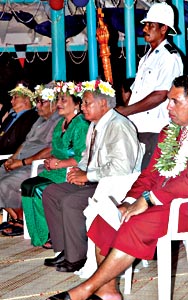
Tokelau's new Ulu, Kolouei O'Brien (centre), is feted at his installation, Feb. 15, 2006. |
Feb. 11-15, 2006: In a referendum, conducted under UN supervision, on whether to become self-governing in association with New Zealand (a status similar to that of the Cook Islands and Niue), 584 votes are cast (representing a 95.0% turnout of the 615 registered voters, who in turn represent an estimated 70% of eligible voters), of which 3 are deemed invalid, 349 are in favour of self-government, and 232 against. Although 60.1% thus favour a change of status, this is short of the two-thirds majority required. The outgoing Ulu-o-Tokelau, Pio Tuia, says: "We feel ashamed that we cannot stand up and determine our own future. That really hurt us, we cannot be free men." The Fono voted unanimously in favour of the deal, which would have seen Tokelau become the 17th member of the PIF. The result is also disappointing for the New Zealand government, which has been strongly promoting the idea of self-determination for Tokelau. It is reported that many people in Tokelau were skeptical of New Zealand's reassurance that financial support - currently around NZ$9 million a year - would continue through a trust fund. After the results are announced on February 15, Kolouei O'Brien (faipule of Fakaofo) replaces Pio Tuia (faipule of Nukunonu) in the annual rotation as Ulu-o-Tokelau.
Late February 2006: Tokelau's director of transport and shipping, Zak Patelesio, says getting a new boat is an urgent priority. Currently the only way to travel to Tokelau is from Samoa fortnightly on a ship that takes more than 24 hours to reach the isolated atolls.
March 2006: Administrator Neil Walter says talks are underway to improve cooperation between Tokelau and Swains Island, which was Tokelau's fourth atoll Olohega before it was annexed by the United States. Walter says while Olohega remains a sensitive issue among Tokelauans the two countries are looking at ways to better share resources.
April 2006: Tokelauan Falani Aukuso is appointed deputy director-general of the Pacific Community.
May 18, 2006: The New Zealand budget includes U.S.$370,000 to be spent over the next three years on a programme to revitalize the Cook Islands, Niue, and Tokelau languages, which are at risk of becoming extinct in New Zealand. The measure would partly fund Cook Island and Tokelau tutors who are fluent speakers but not necessarily teachers. The government says the languages risk being lost within the next 30 years given the small populations still resident in the islands.
June 2006: In the Queen's Birthday New Zealand Honours List three Tokelauans are awarded "for services to the Tokelau Islands": the Ulu-o-Tokelau and faipule of Fakaofo Kolouei O'Brien and faipule of Atafu Pio Tuia are each made an Officer of the New Zealand Order of Merit (ONZM) and the former national general manager and director of the Council for the Ongoing Government Falani Aukuso is made a Companion of the Queen's Service Order (QSO).
August 2006: It is reported that the Taupulega of Atafu has forced out some of its members who refuse to go to church because of Pastor Faamaoni. Maka Toloa, a former law commissioner of Tokelau, says six members have been banned from the 15-member council and a seventh has walked out in protest at their treatment. "It seems the legal system of Tokelau has failed us badly and that our human rights have been breached to a point where totalitarian rule and absolute power is the order now for Tokelau and that our democratic rights as a citizen have been absolutely breached and violated," says Toloa, who left Atafu in late 2005 to live in Wellington because of his disapproval of the situation with the pastor.
August 2006: The General Fono makes a unanimous decision to hold a second referendum for self-determination in November 2007.
Oct. 17, 2006: New Zealand announces the appointment of diplomat David Payton as Tokelau's administrator, prompting criticism from National Party MP John Hayes that a qualified Tokelauan should have been appointed.
November 2006: It is alleged that the independence moves are partly to blame for a recorded drop in Tokelau's population. Preliminary census data from Statistics New Zealand state that on October 19 the population was 1,153, down 20% from the 2001 census figure of 1,449. The matter of Pastor Faamaoni is also blamed for the population drop. Late in December Tokelau census manager Kelekolio Kelekolio comes up with a new de jure usually resident population count of 1,466, or 17 people up on the 2001 figure. The new number consists of 1,074 people who were on the atolls on census night, plus the usually resident absentee population of 392 (including 33 Tokelauans who are in the public service based in Apia with their families, and 359 transferred hospital patients, students studying outside of Tokelau, and those people visiting overseas who qualified as usual residents under the specified criteria). The distribution by atoll is: Atafu 524, Fakaofo 483, Nukunonu 426.
Nov. 18-23, 2006: The particular needs of Tokelau are the focus of a fact-finding mission. Led by the Secretariat of the Pacific Community, regional organizations "review the capacity in the territory and will identify its needs over three years."
2007: St. Joseph's Hospital on Nukunonu is rebuilt and equipped as the national referral hospital. This means that those who cannot be treated on Atafu or Fakaofo will be referred to St. Joseph's Hospital and then, when necessary, overseas.
March 2007: The faipule of Fakaofo, Kolouei O'Brien, declares that if the islands achieved greater autonomy then Tokelau would wish to enter immediate negotiations with the U.S. regarding the return of Olohega.
Sept. 12, 2007: It is reported that the GDP of Tokelau has been boosted by 10% since marketing its Internet domain suffix ".tk" through a Dutch entrepreneur, Joost Zuurbier, founder of Dot TK. In addition to revenues from users of the suffix, the deal provided the 1,500 islanders with computers and Internet telephony.
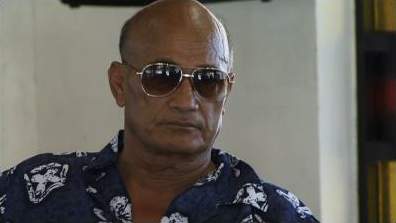
Ulu Kuresa Nasau digests the referendum result, Oct. 24, 2007. |
Oct. 20-24, 2007: A new referendum is held on the question of becoming a self-governing nation in free association with New Zealand. Of 692 valid votes (there were 789 registered voters), 446 (64.4%) are in favour and 246 (35.6%) oppose. Thus the proposal again fails - falling short by 16 votes of the necessary two-thirds majority. Ulu Kuresa Nasau had predicted a decisive victory for self-government. There is speculation about the influence of Tokelauans living in New Zealand, although expatriates were not permitted to cast a vote. New Zealand prime minister Helen Clark assures Tokelauans of New Zealand's "ongoing friendship and support" and continued efforts to improve public services and upgrade essential infrastructure.
Jan. 18-19, 2008: Elections are held to the General Fono, this time consisting of 20 seats: according to the last census, 7 in Fakaofo, 7 in Atafu, and 6 in Nukunonu. Pio Tuia is reelected as faipule of Nukunonu and Kuresa Nasau as faipule of Atafu, while Foua Toloa is chosen as the new faipule for Fakaofo, taking over from longtime incumbent Kolouei O'Brien. New pulenuku are Tinielu Tumuli in Fakaofo, Lino Isaia in Nukunonu, and Nouata Tufoua in Atafu. The government is subsequently formed as follows:
| Foua Toloa | Finance; Telecommunication; Energy; Transport |
| Pio Tuia | Health; Support Services |
| Kuresa Nasau | Economic Development, Natural Resources, and Environment; Education |
July 31, 2008: The deputy director-general of the Pacific Community, Tokelauan Falani Aukuso, dies unexpectedly in Suva, Fiji. Fijian police determine the cause of death as suicide.
July 2009: The leader of Tokelau tells the UN special committee on decolonization that the General Fono has decided to defer consideration of any future acts of self-determination following the holding of two UN-sponsored referendums in 2006 and 2007.
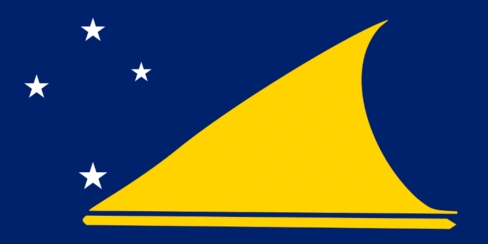
Sept. 7, 2009: Tokelau launches its own flag, replacing the New Zealand flag for use in official ceremonies. The parliament in 2007 proposed a flag containing four stars, roughly positioned according to the locations of the atolls, but also including Olohega (Swains Island); this was modified in 2008 in a compromise still including four stars but arranged in the shape of the Southern Cross. The flag depicts a stylized Tokelauan canoe, symbolizing Tokelau's journey towards finding the best governance structure for its people, sailing towards the Southern Cross, symbolizing a navigational aid for the journey.
April 14, 2010: At a meeting of the South Pacific Whale Research Consortium, Tokelau declares its intention to outlaw whaling in its 290,000-sq-km exclusive economic zone, making it the 11th Pacific Island entity to do so. Despite not having been consulted prior to the decision, the New Zealand government supports Tokelau's bid to implement the ban on whaling.
November 2010: Three teenagers from Tokelau are rescued after drifting some 1,300 km over 50 days aboard a small boat in the Pacific. They survived on rainwater, coconuts, and a seagull.
2011: The three atolls experience prolonged drought and on October 3, with less than a week's water supply left for their 1,300 inhabitants, a state of emergency is declared. A joint New Zealand-U.S. operation oversees the distribution of containers flown from New Zealand to American Samoa, where water is loaded for delivery to the atolls by the U.S. Coast Guard. The Secretariat of the Pacific Regional Environment Programme (SPREP) disburses funding to Tokelau, and Samoa also provides assistance. Following the first substantial rainfall in nearly six months, the state of emergency is rescinded in late October. SPREP pledges to assist Tokelau in long-term water resource management planning.
Jan. 19-20, 2011: In Atafu elections, long-standing faipule Kuresa Nasau is replaced by Kelihiano Kalolo and Faafetai Taumanu is elected the atoll's mayor. In Nukunonu, a previous faipule, Salesio Lui, replaces Pio Tuia, who did not seek reelection, and a former mayor, Panapa Sakaria, is elected as mayor, defeating Lino Isaia in a runoff. In Fakaofo, Foua Toloa is reelected as faipule and Tinielu Tuumuli as mayor. All are inaugurated on March 11. The portfolios are as follows:
| Foua Toloa | Finance; Telecommunication; Energy; Transport |
| Salesio Lui | Health; Support Services |
| Kelihiano Kalolo | Economic Development, Natural Resources, and Environment; Education |
Sept. 7, 2011: Tokelau declares its entire exclusive economic zone of 319,031 sq km a shark sanctuary.
Sept. 29, 2011: It is reported that the General Fono has voted to move the island nation notionally west of the international date line, following the example of neighbouring Samoa, where the legislature in June passed a bill on crossing the date line. Tokelau's administrative offices are sited in Apia (the capital of Samoa). Both Tokelau and Samoa wish to be in the same time zone as Australia and New Zealand, with which they have strong economic links. As planned, both Tokelau and Samoa skip one calendar day to jump from December 29 to 31.
Oct. 18, 2011: Census population: 1,411 (Atafu 494; Fakaofo 510; Nukunonu 407).
November 2011: Tokelau is one of eight Pacific states and territories that jointly establish the Polynesian Leaders Group, which is broadly viewed as being intended to provide a counterweight to the Melanesian Spearhead Group.
Dec. 8, 2011: Tokelau announces at the Durban climate change talks that it will be the world's first territory to switch entirely to renewable energy. Ulu Foua Toloa says: "We will be among the first to go under water. Already we are suffering extreme weather, storm surges, droughts, coral-bleaching, inundation of land, and groundwater salination."
2012: Tokelau faces another year of drought as the wet-season rains fail.
2012: Tokelau joins a Pacific tuna cartel known as Parties to the Nauru Agreement (PNA). This becomes highly lucrative for Tokelau.
June 2012: The minister for finance, telecommunications, energy, and transport, Foua Toloa, is stripped of his cabinet portfolios for not precisely explained reasons ("It has got to do with shipping decisions"). The finance and transport portfolios are passed to Kelihiano Kalolo. Only in February 2013 it is revealed that the relationship between New Zealand's foreign minister, Murray McCully, and Toloa broke down after Toloa ordered the dilapidated MV Tokelau (which provided the territory's only link with the world for a decade) to sail against the wishes of McCully, who viewed the boat as unseaworthy. McCully, who considered he would have been held responsible if the boat had sunk, thereafter indicated he could not work with Toloa. The MV Tokelau was subsequently replaced by the newer PB Matua.
Aug. 29, 2012: On the sidelines of the PIF convening in Rarotonga, Cook Islands, maritime boundaries are formalized in treaties involving the Cook Islands, Marshall Islands, Kiribati, Tuvalu, Niue, Tokelau, and Nauru, allowing for collaborative efforts aimed at sustainable development and protection of marine resources.
Nov. 7, 2012: New Zealand foreign minister Murray McCully says that Tokelau has become the first territory in the world to meet all its electricity needs with solar power. A U.S.$7 million project, funded by New Zealand, to build solar grids on the territory's three atolls has just been completed. Previously Tokelau, like many other Pacific islands, was entirely dependent on expensive, environmentally harmful diesel-fuelled electricity generation.
March 2013: New Zealand criticizes the UN Decolonization Committee's unanimous choice of Syria's UN representative as the committee's rapporteur, allowing him to investigate and comment on New Zealand's stewardship of Tokelau, given Syria's own ongoing violations of democratic principles and human rights norms.
April 2013: It is reported that Tokelau and New Zealand are jointly to formulate a strategic plan to enhance the performance and development of the Tokelauan police force.
May 2013: It is announced that the three pulenuku are to be given ministerial responsibilities within the Council for the Ongoing Government. Hitherto all portfolios were held by the three faipule. In the same month proposals are mooted for the introduction of a formal reservation of a number of seats for women in the General Fono.
June 2013: The Ulu complains to a UN-sponsored seminar about the territory's inability to access UN funds to deal with climate change challenges because of its UN classification as a "colony."
September 2013: The New Zealand government announces a five-year, NZ$5 million initiative intended to assist five Pacific states vulnerable to water shortages, including Tokelau, better to manage their freshwater resources.
Jan. 23, 2014: Elections are held to the General Fono. Foua Toloa from Fakaofo is the only faipule to be reelected, while Siopili Perez is elected in Nukunonu and Kuresa Nasau in Atafu. The pulenuku from Nukunonu and Atafu, Panapa Sakaria and Faafetai Taumanu, are reelected and Mose Pelasio wins his first term as pulenuku of Fakaofo. Contrary to this report, however, Saili Patea Peau subsequently appears in Taumanu's position, thus becoming the first female on the council. The portfolios are as follows:
| Siopili Perez | Finance; Health |
| Foua Toloa | Energy; Transport |
| Kuresa Nasau | Economic Development, Natural Resources, and Environment; Sports |
| Saili Patea Peau | Education |
| Panapa Sakaria | Support Services |
| Mose Pelasio | Telecommunications |
July 31, 2014: Tokelau's status at PIF is upgraded to associate membership.
Aug. 27, 2014: Former administrator (1975-85) Frank Henry Corner dies.
November 2014: Kolouei O'Brien is appointed faipule of Fakaofo, replacing Foua Toloa due to medical reasons. However, O'Brien dies May 11, 2015, shortly before Toloa who dies on June 23.
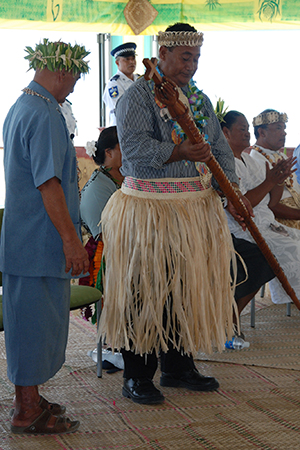
Outgoing Ulu Kuresa Nasau (left) hands over the staff of authority, the tokotoko, to Siopili Perez to become the new Ulu, Feb. 23, 2015. |
Jan. 2, 2016: Former administrator (1985-88) Harold Huyton Francis dies.
July 2016: The General Fono's recognition of climate change as a national development priority leads to the establishment of a strategic climate change programme for 2017-30, entitled "Living with Change." The programme focuses on strengthening Tokelau's coastline to withstand the impact of storm surges and rising sea levels; increasing the use of renewable forms of energy; and human development.
July 30, 2016: The pulenuku of Nukunonu, Panapa Sakaria, dies on his atoll at 57. He is succeeded later in the year by Petelo Patelesio.
Oct. 18, 2016: Census population: 1,499 (Atafu 541; Fakaofo 506; Nukunonu 452).
January 2017: In parliamentary elections held on January 23 (Nukunonu), 27 (Fakaofo), and 31 (Atafu), 21 nonpartisan members are elected. Incumbents Siopili Perez and Afega Gaualofa are reelected as faipule for Nukunonu and Fakaofo respectively, while Kelihiano Kalolo is elected faipule for Atafu. The ministerial allocations on March 9 are as follows:
| Siopili Perez | Finance; Health |
| Afega Gaualofa | Transport; Energy |
| Kelihiano Kalolo | Economic Development, Natural Resources, and Environment; Public Service Commission |
| Fano Faiva | Education |
| Petelo Patelesio | Support Services |
| Mose Pelasio | Telecommunications |
The Public Service Commission headed by Kalolo is newly established.
March 2017: The Ulu, Siopili Perez, denounces a proposal by the New Zealand government to give the administrator the power of veto over Tokelau's development funds for any projects costing more than NZ$500,000, arguing that it would undermine Tokelau's relative autonomy. The proposed change (which is not ultimately implemented) was apparently prompted by the recent purchase by the territory's authorities of two helicopters (for almost NZ$3.3 million) without consulting the New Zealand government. Perez announces in late March that Tokelau will sell the two helicopters. The public service general manager since 2007, Jovilisi Suveinakama, and the finance director, Heto Puka, are suspended in April and removed from their positions in December; in 2018 they launch legal action against the government, Ulu Gaualofa, and the administrator.
June 2017: Ulu Perez launches Tokelau's climate change adaptation strategy at the UN Oceans Conference in New York City, including a target for total reliance on solar energy as a source for domestic power by 2030 (from some 80% in 2017).
July 2017: Two new departments are established, a Climate Change Agency and a Fisheries Management Agency, with Kalolo and Pelasio as ministers respectively.
August 2017: Administrator David Nicholson is removed after only seven months in office, at the request of the Council for the Ongoing Government, amid tension arising from the helicopter controversy. Late in the month Jonathan Kings (who held the post already in 2011-15) is appointed as administrator.
Oct. 26, 2017: Kris Faafoi becomes the first New Zealand cabinet minister of Tokelauan descent.
November 2017: The New Zealand government announces that the UN Framework Convention on Climate Change and the Paris Agreement, which were agreed in December 2015, will henceforth apply to Tokelau, after a request from the General Fono.
Dec. 15, 2017: Ross Ardern is appointed as administrator, to take office in early 2018.
2018: The number of Tokelauans living in New Zealand has risen to 8,676. Almost half of these live in Porirua and Lower Hutt in the Wellington region.
Feb. 8, 2018: Former administrator (1992-93) Brian Absolum dies.
May 2018: Ross Ardern, New Zealand's erstwhile high commissioner of Niue and father of recently elected prime minister Jacinda Ardern, becomes administrator of Tokelau.
May 2018: A "ship to shore" project, jointly funded by the governments of Tokelau and New Zealand and undertaken by an Australian company, is launched to improve access to Tokelau. By late 2019 wharves on Atafu, Nukunonu, and Fakaofo have been built.
July 31, 2018: It is reported that, in response to the helicopter controversy, the General Fono in November 2017 limited some of the powers of the Council for the Ongoing Government and the Ulu and returned some control to the Taupulega, which are henceforth to be informed of all government operations and decisions.
Early October 2018: Faafoi becomes the first New Zealand minister to visit Tokelau since 2004.
Early October 2018: Administrator Ardern announces an increase in funding to help Tokelau improve its financial management, after it emerged that there was a large backlog of unaudited accounts.
Nov. 12, 2018: A New Zealand act making changes to the government-funded superannuation programme, which will make it easier for Cook Islanders, Niueans, and Tokelauans to receive pensions in their home islands, receives royal assent.
February 2019: In Wellington, New Zealand, the Tokelau High Court conducts its first-ever full hearing (the Wellington High Court is sitting as the Tokelau High Court, a request that the trial take place in Tokelau having been rejected by New Zealand's chief justice) in the case of the two former Tokelau public servants, Puka and Suveinakama. According to the court's verdict, which is delivered in July, they were not unfairly dismissed, but their salary was unlawfully withheld while they were suspended prior to dismissal. The court ruled that English common law is in effect in Tokelau, except to the extent it is excluded by any enactment or is inapplicable to the circumstances of Tokelau, and therefore the Employment Relations Act 2000 (New Zealand legislation) does not apply; instead, the common law of contracts applies.
Late July 2019: Jacinda Ardern becomes the fourth New Zealand prime minister to visit Tokelau. Meeting with Tokelauan leaders, she discusses the islands' development in health, education, and infrastructure, and announces NZ$6 million worth of investment in the solar electricity network.
September 2019: New Zealand prime minister Jacinda Ardern uses Tokelauan greetings and describes the environmental issues confronting the people of Tokelau in her opening speech at the UN Climate Action Summit in New York City.
Nov. 14, 2019: The Ulu announces that the territory's first airstrip will be built (with New Zealand funding) on its largest atoll, Nukunonu, following agreement from the General Fono.
December 2019: Tokelau's minister of communications announces that the government, jointly with the New Zealand government, will be funding the Southern Cross NEXT submarine cable, which will enable faster and more reliable Internet access for the people of Tokelau.
Dec. 12, 2019: It is reported that the auditor-general has been unable to find how Tokelau's government spent over NZ$10 million. The latest available audit for the year ended June 2015 found insufficient documentation to support NZ$9.9 million in personnel costs, as well as for a further NZ$1 million in revenue from a community services levy. Former finance director Puka says "documentation was always a problem."
Jan. 23, 2020: In parliamentary elections, the number of delegates elected is increased to 22 (with an extra member for Fakaofo). Siopili Perez and Kelihiano Kalolo are reelected faipule for Nukunonu and Atafu, respectively. Fofo Tuisano is elected faipule of Fakaofo and will serve as Ulu beginning in March. Faamanuia Tamoa becomes pulenuku of Atafu for the first time; in Nukunonu, Lino Isaia is newly elected although he served in the role previously, while in Fakaofo Mose Pelasio is reelected for his third consecutive term.
March 9, 2020: Fofo Tuisano is inaugurated as Ulu, prior to the first session of the General Fono, when the new government takes office, as follows:
| Siopili Perez | Finance; Health |
| Fofo Tuisano | Transport; Energy; Public Services |
| Kelihiano Kalolo | Education; Climate, Oceans, and Resilience |
| Faamanuia Tamoa | Economic Development, Natural Resources, and Environment |
| Lino Isaia | Support Services |
| Mose Pelasio | Telecommunications; Fisheries Management Agency |
Late March 2020: Inbound travel restrictions have been put in place, food supplies bolstered, and treatment facilities established on all three atolls in reaction to the COVID-19 pandemic. However, in July and again in October the Council for the Ongoing Government expresses concern that it would not be able to cope with cases of COVID-19, highlighting the lack of testing capacity and medical staff.
May 11, 2020: The faipule of Atafu, Kelihiano Kalolo, is reported to be preparing a parliamentary proposal to hold another referendum on Tokelau's status by 2025. He is considering three options for the public vote: independence, self-government in free association with New Zealand, or integration with New Zealand, with the notable exclusion of the status quo as an alternative. However, the submission of the proposal to the General Fono is subsequently delayed owing to the COVID-19 pandemic. Only the middle option (comparable to the status of the Cook Islands and Niue) seems realistic. Independence is not considered viable given that Tokelau's population is significantly smaller than that of the smallest existing independent countries (excluding the special case of Vatican City), Nauru and Tuvalu, with roughly 10,000 people each. Nor is it likely that Tokelauans would want to give up their particular identity to become an ordinary New Zealand island group.
November 2020: Shortly after her appointment, New Zealand foreign minister Nanaia Mahuta telephones Ulu Tuisano to discuss how to continue with development projects in the context of the COVID-19 pandemic, and how to ensure Tokelau remains free of the virus. In December Mahuta announces that her government will purchase enough COVID-19 vaccines for immunization programmes throughout its realm, including Tokelau.
Feb. 28, 2021: It is reported that, following a review into Tokelau's system of justice commissioned by New Zealand's chief justice in 2018, which identified failings in the territory, a plan to reform the system is expected. The case of the two former public servants exposed a justice system split by the nearly 4,000-km distance between New Zealand and its dependent territory. The three faipule had to travel by boat to Samoa, and then by plane to Wellington for the hearings.
March 8, 2021: Kelihiano Kalolo is inaugurated as the new Ulu at the first session of the General Fono for the year. Kalolo pays tribute to Samoa for its assistance in the repatriation of more than 100 Tokelauans who had been stranded overseas due to the pandemic. Joining by videolink from New Zealand, Administrator Ardern confirms the New Zealand government's commitment to providing vaccine access for Tokelau.
2022: Faafetai Taumanu replaces Tamoa in the cabinet.
June 1, 2022: Don Higgins is appointed as administrator.
Oct. 18, 2022: Census population: 1,485 (Atafu 499; Fakaofo 539; Nukunonu 447). Approximately 8,600 Tokelauans live in New Zealand.
Dec. 21, 2022: Tokelau reports its first cases of COVID-19, which have been detected at the border of Atafu on December 13-18.
Jan. 26, 2023: In parliamentary elections (for the first time under a unified electoral system, now also allowing Nukunonu candidates to go for more than one post), 20 nonpartisan members are elected (7 each for Atafu and Fakaofo, 6 for Nukunonu; the numbers representing the faipule and pulenuku plus one additional member per 100 population based on the last census numbers rounded to the nearest hundred). Kalolo and Tuisano remain faipule of Atafu and Fakaofo respectively, while Alapati Tavite is elected faipule of Nukunonu. The pulenuku elected are Nofo Iupati (Atafu), Tinielu Tuumuli (Fakaofo), and Petelo Patelesio (Nukunonu). The following cabinet is subsequently formed:
| Kelihiano Kalolo | Education; Climate, Oceans, and Resilience |
| Fofo Tuisano | Transport and Support Services; Energy |
| Alapati Tavite | Finance; Health |
| Nofo Iupati | Economic Development, Natural Resources, and Environment |
| Tinielu Tuumuli | Fisheries |
| Petelo Patelesio | Telecommunications |
June 13, 2024: Former administrator (1990-92) Graham Ansell dies.
Nov. 11, 2024: The government, with support from the UN Development Programme, launches the Tokelau Blue Economy Roadmap and Action Plan 2025-2030, for sustainable ocean management and building a resilient blue economy for the country.
June 2, 2025: In the King's Birthday Honours, Uili Galo, who organized the Fakaofo community in Wellington, is made a Member of the New Zealand Order of Merit (MNZM) "for services to the Tokelau community."
Jan. 23, 2026: It is reported that New Zealand has scrapped a project to build an airport in Tokelau after spending NZ$3 million on the design phase. "This decision was made in the context of the high cost of the project and the constrained fiscal environment currently facing the New Zealand government," the Foreign Ministry says.
February 2026: The PNA terminates Tokelau's participation in its Vessel Day Scheme that manages the purse-seine industry in Pacific waters. Tokelauan and PNA officials describe New Zealand action starting in 2024 to increasingly oversee Tokelau's Fisheries Management Agency - action that Tokelau officials themselves pointed out to the PNA because it threatened the basis on which Tokelau, as a territory of New Zealand, had been accepted into the PNA in 2012, i.e. its ability to exercise a sufficient degree of operational autonomy over the management of fisheries within its exclusive economic zone.
Feb. 5, 2026: In parliamentary elections (postponed from January 29 due to severe weather), 20 members are elected. Kelihiano Kalolo is elected faipule and Malala Lafaialii pulenuku of Atafu, Alapati Tavite faipule and Petelo Patelesio pulenuku of Nukunonu, and Fofo Tuisano faipule and Feleti Tulafono pulenuku of Fakaofo. The following cabinet is subsequently formed:
| Kelihiano Kalolo | Education; Climate Change |
| Fofo Tuisano | Transport and Support Services; Energy |
| Alapati Tavite | Finance; Health |
| Malala Lafaialii | Economic Development, Natural Resources, and Environment |
| Feleti Tulafono | Fisheries |
| Petelo Patelesio | Telecommunications |
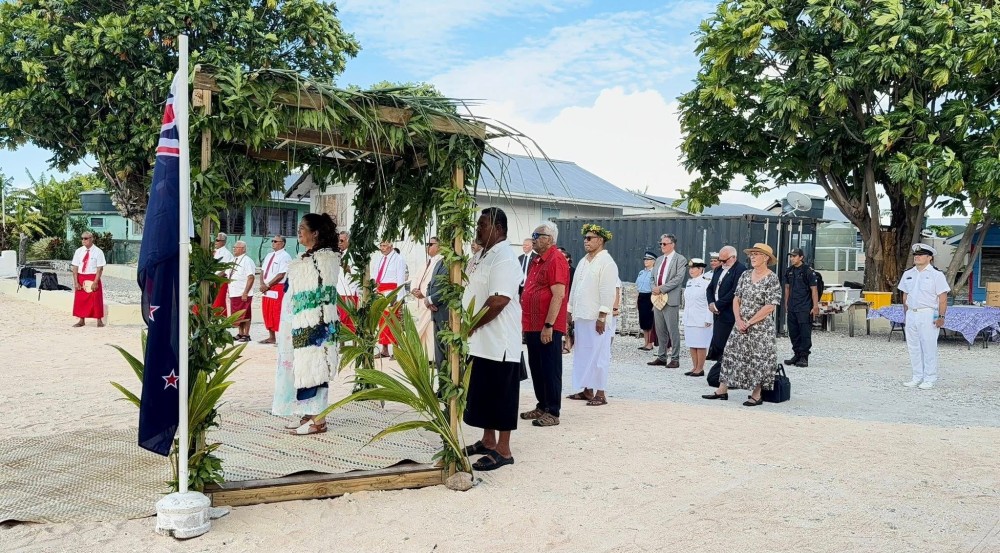
New Zealand governor-general Dame Cindy Kiro (under the shade) attends centenary celebrations in Fakaofo, Feb. 11, 2026. |
Feb. 11-13, 2026: New Zealand governor-general Dame Cindy Kiro visits all three atolls of Tokelau to mark the centenary of New Zealand administration. King Charles III sends a personal message.
July 2, 2026: Andre van der Walt is appointed administrator.
Aug. 29, 2026: Former administrator (1988-90, 2003-06) Neil Walter dies.